States across the nation are tackling the challenge of expanding meaningful work-based learning for all learners. To support these efforts, Advance CTE launched a work-based learning (WBL) Opportunity Gap Analysis (OGA) cohort, extending the broader OGA initiative to help leaders advance and strengthen their WBL systems.
Arizona, Indiana, Oregon, West Virginia, and Wisconsin were selected for the cohort, each bringing a clear commitment to improving WBL opportunities to learners and a wealth of knowledge and experience to act on that commitment.
Through these workshops, Advance CTE provided training, resources, and support to help state leaders define WBL in their state, establish the continuum learners will follow through the education system, and explore common practices associated with WBL accountability systems and reporting. Selected participants spent time in a two-day virtual workshop in March, came together across a six-month collaborative community of practice, and gained access to a suite of resources and tools that helped them to:
- define and inventory their WBL continuum;
- analyze programs within their continuum to identify special populations gaps;
- conduct root cause analyses; and
- plan actions for addressing identified gaps in existing WBL programs.
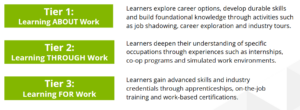
Opportunity Gap Analysis suggested work-based learning continuum
The OGA team worked intentionally with states to help them outline their goals related to WBL and define the actions needed to prepare to hold an in-state version of the WBL OGA workshops.
Arizona: Centering Local Voices
Arizona started the cohort strong by ensuring that they brought local-level voices to the table through including two district CTE directors along with members of the Arizona Department of Education. The state itself is in the midst of revitalizing its WBL definitions, continuum, and data collection requirements so the WBL OGA cohort seemed like a perfect fit to support these efforts. The team leaned into the collaborative environment and used the communities of practice to ask questions and gather best practices together that could help move implementation efforts forward in a learner-focused way.
Indiana: Digging Deeper into Root Causes
A team from Indiana’s Commission for Higher Education joined the initiative as a way to help align and analyze the state’s WBL offerings as part of a larger push stemming from the December 2024 passage of new graduation requirements by the State Board of Education. Indiana Diploma and Readiness Seals provide learners with the flexibility to experience work-based learning as a way to earn credits towards high-school graduation.
The team planned to incorporate a WBL unit into existing performance data labs that are part of the Comprehensive Local Needs Assessment (CLNA) process. The labs were conducted two previous times and were shown to be a valuable tool for districts to spend time reviewing their data in an intentional way and identify targeted, data-informed strategies within their CLNA. In particular, the team wanted to lean in on the Root Cause Analysis phase of the OGA cycle to help identify and expand access points to WBL opportunities.
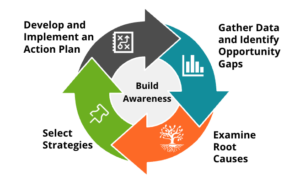
Opportunity Gap Analysis cycle applied in workshops to support a reflective, data-driven approach to WBL data and root cause analysis
Oregon: Sharing Data and Ideas to Impact Learner Access
The Oregon Department of Education team used the Advance CTE cohort to build upon previous Opportunity Gap Analysis experience. They planned a workshop series to identify where additional WBL experiences are needed throughout the state and analyze gaps in WBL access, particularly among special populations as identified by the Carl D. Perkins Career and Technical Act (Perkins V). They started by engaging state-level colleagues to help plan an impactful future train-the-trainer series. The goal of the workshops was to deepen understanding of WBL definitions, Oregon’s six approved WBL types, and their quality criteria.
Participants strengthened their understanding of WBL and data analysis through the WBL dashboard and gained insight into how data-informed decisions can expand access to hands-on career training opportunities. The team looks forward to the next round of train-the-trainer sessions to expand impact with local education partners.
West Virginia: Connecting Education and Labor Data
The members of the West Virginia Department of Education team were critically focused on ensuring that students gain hands-on experience and access for all learners to available career pathways within the state. The team ultimately aimed to use the WBL gap analysis training to help catalog and align current WBL opportunities with the state’s labor market demands. Working to engage and strengthen partnerships with state- and local-level employers to increase the opportunities available to learners.
Wisconsin: Creating Institutional Norms and Quality WBL Experiences
In another first for the Opportunity Gap Analysis initiative, Wisconsin sent a team of postsecondary professionals from Gateway Technical College to complete the cohort as a pilot and potential model for other postsecondary institutions throughout the state. The team decided to start small, and focus on one or two specific Schools within the college to help them gain a more complete picture of WBL offerings across their programs, and to begin designing solutions that would improve their quality work-based learning practices and experiences for learners. The team continues to work alongside Advance CTE as it prepares to launch the next iteration of Gateway’s WBL journey.
Advance CTE continues to check-in with all of our state teams to help support their in-state efforts. Along with continual support of our previous seven cohorts, the organization is getting ready to launch and support several state-level OGA related technical assistance projects in early 2026. These direct supports will center around state-specific versions of the OGA process, and help them to define, inventory, and increase data alignment in the state, school, and program levels.
The Gap Analysis team is always available to chat about your state’s learner access gaps and goals. If your state is interested in participating or enhancing their Gap Analysis work, please reach out via our request form.