
Take a moment to recall the emotions you felt when you secured your first job. Or when you realized you needed to pivot your career path for a new opportunity. Or even younger, when perhaps you had a passion but thought your background prevented you from pursuing that passion.
Did you have someone to help navigate these emotions? Did the emotions you felt impact the decisions you made in the next step of your career journey?
Comprehensive career advising requires wraparound supports that consider the whole learner, including their mental wellness. States and districts can take the lead in norming the career advising-mental health connection by not only having structures for learners to easily access mental health supports, but also empowering career advising professionals with the skills to approach career advising with a mental wellness lens.
As a national leader in Career Technical Education (CTE) policy and state system improvement, we are committed to advancing ideas that build a cohesive career readiness ecosystem so that every learner is able to succeed in the career of their choice.
This blog will explore the link between career advising and mental health, offer recommendations for everyday use of this lens by career advising professionals, and provide a connected career advising framework to integrate a mental health lens into career advising system-wide.
Why Approach Career Advising with a Mental Health Lens
 According to the Youth Risk Behavior 2021-2023 Survey, 40% of high school-aged respondents experienced feelings of sadness or hopelessness that resulted in interruptions of some of their usual activities during the 12 months preceding the survey. Mental wellness can have significant impacts on career development and success. An individual’s mental health is strongly impacted by their past and present physical, social, economic, and emotional environment. Risk factors and trauma impact an individual’s resilience and ability to navigate uncertainty and change. The resulting health outcomes affect both the decisions a learner may make about their career journey, as well as the supports they might need to be successful in a career, education, and life.
There are multiple factors that support mental wellness that are also connected to career success:
- Resiliency: Resilient individuals have healthy coping mechanisms to manage stress, overcome setbacks, and successfully navigate uncertainty and adaptability. Research suggests this can translate to lower absenteeism in the workplace and increased productivity.
- Sense of Belonging: Meaningful connections and positive relationships not only provide a support system in life, but they create an environment that provides networks and support in finding new career opportunities, navigating difficult work environments and career transitions, and more.
- Purpose, interest, and empowerment:When individuals have activities in life and work that align with their interests, they are more motivated, engaged, and hopeful about the future.
- Confidence and self-esteem: Individuals with strong confidence and self-esteem are better able to prioritize their best interests in decisions about life and career, are more assertive and trust their judgement in decisionmaking, and are able to advocate for themselves when navigating their career journey.
Multiple national professional organizations recognize the important link between career advising and mental health:
- The American School Counselor Association (ASCA) has an official position and guidance on the school counselor’s role in supporting mental health.
- The National Career Development Association’s Learning Hub provides multiple courses connecting career development and mental health.
- Earlier this year, the American Counseling Association released Integrating Career Development and Mental Health In Counseling.
- The American Mental Health Counselor Association identifies “academic, vocational, and career development” as a key knowledge area for Licensed Clinical Mental Health Counselors.
Additionally, there is emerging evidence to suggest a correlation between aspects of career development experiences, including CTE, and positive mental health benefits through the focus on building healthy relationships, engaging learning, and developing a clear path for the future. Our own Senior Associate Jodi Langelotti explores this topic in the CTE and Mental Health blog series.
Career advising professionals can incorporate a mental health lens into career advising by asking questions, building skills, and connecting with others in a way that can enhance mental wellness and in turn maximize career success.
Focus Areas for the Mental Health Lens in Career Advising
 Career advising professionals should not be expected to offer mental health counseling or treat mental health conditions in their work with learners unless they have the requisite training. However, adopting a mental health lens in career advising enables professionals to evaluate and offer resources for mental health as needed to support a learner’s overall career development.
The following are areas that career advising professionals can incorporate into their daily processes and interactions with learners to enhance the environment for and delivery of career advising:
Trauma-informed approach
Each learner brings a lifetime of experiences that both positively and negatively impact their mental, social, and physical well-being and therefore their approach to explore, prepare for, and sustain a career. Adopting a trauma-informed approach in career advising can uncover information that not only allows for better alignment of learner needs with supports, but can also identify opportunities to increase through specific skillbuilding and career readiness experience such as work-based learning or building social capital.
Psychological safety and inclusion
Cultivating environments where learners can bring their authentic self to conversations about their career journey is central to ensuring the actions recommended through career advising consider and align with their lived experiences and needs. Additionally, career advising should not be a one-way directive, but a collaborative partnership that empowers learners, achieved through building trust and genuine relationships. Learners may be facing stressors that make it difficult to focus on navigating their career, or navigating cultural considerations in pursuit of particular fields or jobs.
Mental Health Support for Career Advising Professionals
High-quality career advising depends on the well-being of those who provide it. In addition to incorporating a mental health lens into career advising delivery, mental health support to career advising professionals should be an expected and consistent part of the workplace experience. Finding ways to prevent burnout can be helpful.
This support should also extend to professional development that provides skill- and knowledge-building on what mental health supports are available to learners, as well as the ‘when’ and ‘how’ of a referral to a mental health professional when appropriate.
Get added to our email list for regular updates and resources connected to high-quality career readiness.
Leveraging A Connected Career Advising Approach
While the previous section provides easily applied focus areas to incorporate a mental health lens into career advising, achieving this across all roles that deliver and support career advising requires intentional systems design and change.
Advance CTE’s most recent resource on career advising introduces the concept of connected career advising. This approach focuses on building intentional and widespread structures that connect career advising wherever it happens across education, workforce, and community settings. This includes connecting career advising to systems that provide resources, such as mental health support, to enhance learner access and opportunity.
Connected Career Advising offers four elements that, when applied to support a mental health lens in career advising, builds systems that improves access to information and resources, expands professional development opportunities, and increases efficiency and productivity in how career advising is delivered. These outcomes benefit learners as well as the career advising professionals who support them. The following strategies can be applied by state, districts, and community leaders to integrate focus areas of mental health in career advising on a systemic level.
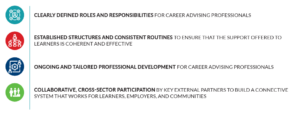
Element 1: Clearly defined roles and responsibilities for career advising professionals
- Map which career advising roles already or should include conversations about learner mental health in their work, and how those roles connect across systems;
- Identify specific responsibilities and skills connected to mental health for each role connected to career advising; and
- Identify existing policies and procedures that connect career advising and mental health.
Our Connected Career Advising Toolkit provides a ready-made Role Mapping activity.
Element 2: Established structures and consistent routines to ensure coherence and effectiveness in the support offered to learners
- Identify and connect existing definitions, policies, and processes for mental health support in education and/or communities;
- Develop protocols that clearly define expected conversations with learners on mental health and when to refer for additional support;
- Establish routines to regularly receive input from both learners and leaders on the fidelity of mental health protocols in career advising as well as areas of success and growth; and
- Conduct regular convenings between leaders connected to both career advising and mental health.
Element 3: Ongoing and tailored professional development for career advising professionals; and
- Offer ongoing professional development opportunities that provide cross-training for mental health and career advising professionals and leadership;
- Provide ongoing professional development opportunities to offer mental health support to career advising professionals;
- Develop a clearinghouse that compiles information on mental health skillbuilding and direct supports;
Element 4: Collaborative, cross-sector participation among key external partners to build a connective system that works for learners, employers, and communities.
- Evaluate current avenues for career advising professionals to receive information or direct services for mental health across education, workforce, and community spaces;
- Collaborate with partners on professional development about mental health for professionals who offer career advising.
Resources for Application
The following resources cover key topics that link mental health support to career advising for both learners and professionals. Inclusion of these resources does not constitute an endorsement by Advance CTE.
American School Counselor Association – Crisis and Trauma Resources
Colorado Department of Education: Landscape of Well-Being and Belonging
Creating Safe Spaces as a School Counselor
Crisis and Trauma Resource Institute Training
Harvard Business School – Psychological Safety
NACADA: The Global Community for Academic Advising – Well-Being and Advisor Retention Resources
National Career Development Association Learning Hub
Learn more about promising state and local practices to implement connected career advising and explore ready-made activities in our Connected Career Advising explainer and toolkit
Stacy Whitehouse, with contributions from Lauren Jones, NCC CSCDA LPCc, CTE program director for special populations, Counseling & Career Development, CTE in Colorado/Community College System