

Across the country, the demand for skilled educators to prepare learners for evolving career pathways continues to grow. The rise of new industries and technologies, including artificial intelligence, biotechnology, and fintech, among others, has accelerated the need for high-quality Career and Technical Education (CTE) programs that are responsive to industry needs. The launch of the modernized National Career Clusters® Framework underscores this national effort to align education with the changing world of work.
More than anything, our CTE programs rely on the educators who deliver them. Retaining and supporting these educators through preparation, ongoing professional learning, and meaningful career advancement opportunities is essential to sustaining high-quality CTE programs.
Drawing from four studies featured in Advance CTE’s Research Warehouse Dashboard, this Research Round-Up highlights the challenges of recruiting, developing, and retaining CTE educators and highlights promising strategies for building a strong and sustainable CTE educator workforce.
Research Highlights: Building and Sustaining the CTE Educator Workforce
CTE Educator Shortages Persist
Persistent educator shortages continue to challenge CTE programs at both the secondary and postsecondary levels. A National Center for Education Statistics (NCES) study found that during the 2020–21 school year, nearly one in three public schools hiring for at least one position struggled to fill CTE roles. One impact of the struggle to find qualified CTE educators is that CTE educators in grades 9-12 were more likely than educators in many other subjects to be new to the profession, with less than three years of experience. Figure 1 shows the percentage of public school teachers in grades 9-12 with less than three years of teaching experience by subject area.
Figure 1
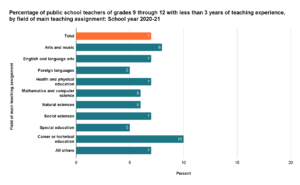
Note: This figure was adapted from Career and Technical Education in the United States, National Center for Education Statistics, National Teacher and Principal Survey.
Recruiting Challenges in Postsecondary CTE
Similar challenges extend to postsecondary institutions. In a study of North Carolina’s community colleges, Hensley et al. found that most institutions reported consistent difficulty recruiting and retaining qualified CTE faculty, particularly in high-demand fields such as health sciences, construction, and information technology. Respondents cited several common barriers:
- 66% of respondents said hiring full-time CTE faculty was “often” or “always” difficult
- 60% reported similar difficulty hiring part-time faculty
- Faculty shortages were most common in health-related programs (49.7%), followed by construction (27.5%), information technology (22.8%), and engineering (20.5%)
- Some colleges reported shortages across all major CTE areas, indicating system-wide staffing gaps
The study found that while most colleges rely on posting positions on institutional websites or job boards, a few are beginning to explore more sustainable approaches, such as partnering with local K-12 CTE programs, local employers, alumni, and professional associations to strengthen the educator pipeline and leverage “grow-your-own” initiatives.
Supporting and Retaining CTE Educators
Just as important are strategies that retain educators once they enter the classroom. The Hensley et al. study emphasized the importance of addressing burnout, valuing faculty input in decisionmaking, and creating clear opportunities for career advancement. Offering competitive and family-sustaining wages, along with supportive workplace policies, was also shown to improve retention among CTE faculty.
Additional research highlights the importance of targeted professional development in ensuring that educators feel engaged and valued. A study by Ferand et al. in Virginia found that CTE teachers, whether credentialed traditionally or alternatively, share common needs:
- Managing stress and balancing work and personal life
- Improving instructional practices and classroom management
- Connecting academic content to real-world applications
Educators also value training that is tailored to their specific backgrounds. Alternatively certified teachers bringing industry experience benefit from support in classroom management and adapting instruction to meet learner needs, while traditionally certified teachers seek help linking theory to practice.
Complementing this, a study by Nachman & Wernimont (2024) in North Carolina found strategies that community college CTE faculty translate industry experience into effective teaching:
- Incorporating professional scenarios and work-based learning into projects
- Using flexible, hands-on strategies like simulations and peer learning
- Collaborating with industry partners and advisory boards to keep offerings relevant and grounded in labor market demand
- Guiding learners toward real-world experiences, such as internships and apprenticeships
Together, these findings show that recruiting CTE educators and investing in their ongoing development are inseparable goals. Building sustainable educator pipelines requires both attracting new talent and equipping current educators with the support, skills, and resources they need to thrive.
Connect Research to Your Work
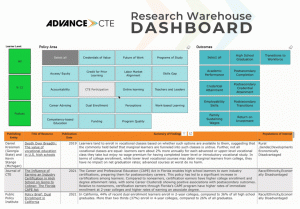
- Advance CTE continues to track and share evidence-based research related to 18 areas of CTE policy and practice. Explore the dashboard to access additional studies on the CTE educator workforce and other key topics.
State and Local Strategies for Improving the CTE Educator Workforce
- This Advance CTE member-only resource presents common challenges in the CTE educator workforce, identifies promising practices, and provides actionable strategies and recommendations.