
A bold commitment to high-quality career pathways, systems change, access, and opportunity for all learners led to the creation of a national career pathways transformation model through the New Skills ready network, as well as a lot of lessons learned along the way.
The New Skills ready network bolstered JPMorgan Chase’s efforts to support a robust economic recovery as part of their $350 million, New Skills at Work initiative to prepare people for the future of work. As part of this five-year initiative, Advance CTE and Education Strategy Group worked with six sites to improve student completion of high-quality career pathways by connecting local and state partners in six US communities—Boston, Massachusetts; Columbus, Ohio; Dallas, Texas; Denver, Colorado; Indianapolis, Indiana; and Nashville, Tennessee.
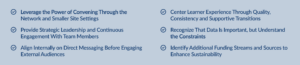
Advance CTE’s final report for the initiative shared this national model, highlighted successes of the initiative, and shared the following lessons learned for what it takes to build and sustain high-quality career pathways based on interviews with all six site teams:
Our own Executive Director Kate Kreamer has helped lead this initiative since its original iteration as New Skills for Youth in 2016, and as a result has her own reflections to share. The following conversation includes reflections and insights from Kate and Dr. Laura Maldonado, senior research associate and Advance CTE’s data lead for this initiative.
How did the New Skills ready network stand apart from other career pathway transformation efforts you’ve been a part of? What did Advance CTE bring to the table?
Kate: What stands out the most is the time and space that the sites had to innovate and refine. They had five years to not only interrogate their system through conducting a needs assessment process, building a plan, and executing the plan, but also then actually had the opportunity to make mid-course corrections along the way. A lot of other philanthropic initiatives are two years or less but the longer timeframe really allowed for experimentation and innovation as well as the ability to see real outcomes. That is incredibly rare.
In terms of what Advance CTE brought to this effort, first and foremost, we brought a system lens. These were locally focused investments, but we didn’t want this to be a programmatic experience. We wanted it to be systematic, which is why there were both local and state partners on each site’s leadership team. We also obviously brought a lot of Career Technical Education (CTE) expertise. If you look at the six sites, all of them were leveraging and building on their CTE infrastructure, including CTE programs of study, funding, and educators, to improve pathways and expand access to those learners not being served by CTE sufficiently.
What leadership practices helped sites keep the work moving forward, especially during challenging or uncertain moments?
Kate: The site leads, all of whom were intermediaries, were all very ambitious in what they wanted to achieve, but each made a strategic decision to slow down, especially on the front end. They had to get the leadership structures right and the relationships in place. They had to build trust, establish a foundation, and make it worth everyone’s time to move forward. A common refrain that emerged among New Skills participants was that “work moves at the speed of trust.”
Ongoing engagement and transparency with partners were other critical leadership practices. The New Skills ready network was an initiative that included many partners, many of whom were already sitting at other tables together. Site leaders were able to bring other efforts and initiatives into the leadership team meetings for better collaboration and connection.
There was also a strong commitment to improving systems—those involved were willing to make changes and do things differently, which may sound easy but we know is very hard.

Would you share a bit more about knowledge-sharing practices? As you mentioned, the intermediaries were bringing in different entities into the space. Some partners had worked together before and some hadn’t so they had to strengthen those partnerships.
Kate: Yes. We saw the leadership teams and working groups grow over time, which contributed to a need for knowledge-sharing practices. We heard from intermediaries that the biannual convenings continued to provide value because new people were being continually onboarded to this work and meeting peers across the country. Site teams were also benchmarking their own progress and gathering promising practices from other sites. Five years of biannual convenings is a lot, but it was an effective way to bring more people into the fold.
The national partners also hosted monthly calls for the intermediaries, similar to an affinity group. Agendas were based on current topics and what they were grappling with from a strategic perspective. The six organizations built really strong and trusted relationships with one another. It was an open space where people were willing to be vulnerable, share their challenges, and solve problems together.
We saw sites center the voices of learners in the work. What were some of the practices used by sites to involve learners in the design and decisionmaking processes?
Kate: It was really exciting to see how sites identified ways to center learner voice, whether it was lifting up learner voice in meeting spaces or creating a platform or forum for learners to communicate their cares and concerns. We increasingly saw learners attend our biannual convenings, present on the work, and share their experiences with other sites.
Denver’s annual L/Earner Voice Symposium is one of the strongest examples continuing on from the New Skills ready network. Another example was that Columbus hired a communications firm early on to do research and engage learners and families to understand what’s working and what’s not working. Their site was thinking about how we better communicate about pathways from the beginning. The sophisticated way of engaging learners and doing so authentically really evolved over time through the initiative.
One of the lessons learned was the recognition that data is important, but that there will always be constraints to seeing the full picture. What advice would you offer to others about using data to inform decisions but not letting constraints slow progress?
Kate: One lesson I would offer is to not let perfect be the enemy of the good regarding data. Prioritization of data and recognition that gathering data is an incremental progress were two items that stood out in the initiative. Both quantitative and qualitative data provide meaning. Engaging learners and industry partners really helped sites fill some gaps missing in the quantitative data.
Another lesson was that sites increased their investments in data analytics, public reporting, and data literacy efforts. Sites were using data strategically to identify gaps in learner access, enrollment, or pathways. They also had to decide what data are needed at the moment to make decisions about which efforts or initiatives to scale. There is a lot of information that can be derived with the right skills and tools to analyze and review data. Even though they couldn’t solve everything, they continued to make improvements to their data collection and analysis processes wherever possible.
One constraint that we had in the initiative was trying to establish consistent data definitions across sites. We learned that lesson through New Skills for Youth, and we tried to address this early in the New Skills ready network initiative. We wanted to allow for local flexibility with pathways, but we also wanted to have consistency for comparison across sites. This proved challenging, and we were not able to accomplish this at the national level through the evaluation work, unfortunately.
Laura: The site teams walked away from the initiative with a deeper understanding of both the opportunities and challenges related to data in their systems. They were able to make changes that helped other data efforts for other projects.
You are someone who previously worked with states on career pathway development as part of the New Skills for Youth initiative. How did the New Skills ready network initiative further your thinking around career pathway development that can be used to support state career readiness leaders?
Kate: New Skills for Youth was a state initiative. The teams were made up of state-level secondary, postsecondary, and workforce partners. There were some employer partners and local districts, but it was really about building state systems. This led to improved outcomes, policy changes, system changes, and structures that are, many of which are still thriving today.
A lot of the site conversations were still at the system level, especially at the district and regional level. So there was comparability in terms of systems thinking in both initiatives. The big difference from the New Skills ready network initiative was the focus on local implementation, on-the-ground efforts and scale-up. It was also fascinating to see how state policy was implemented in a number of these sites, including policies developed under New Skills for Youth.
Before the New Skills ready network initiative, the field was not really talking about intermediaries like they are today. For example, people would mention intermediaries in work-based learning spaces, which was often just a point of contact.
The New Skills ready network illuminated the importance of intermediaries in scaling career pathway development as conveners and trusted partners. They can’t do it alone by any means, but I think there was a big shift that we’re now seeing play out in a lot of other initiatives. There is a focus by funders and other national partners on how intermediaries can strengthen career pathway efforts.
Laura: Yes, I resonate with originally thinking about intermediary roles as the work of one or two people at a college or school. The New Skills ready network showcased some strong examples of intermediaries making movement in career readiness and pathway spaces.
Kate: It was a very different conversation 10 years ago, and I don’t think we had as many examples, proof points, and understanding of the role they play. There weren’t major investments in career pathways or CTE. It was very siloed. Intermediaries are receiving the recognition they deserve as CTE and career pathways have become a national priority.
What is one thing you are most proud of as this initiative comes to a close?
Kate: JPMorgan Chase’s investment helped serve as a catalyst for the prioritization of career pathways. People were paying more attention to career pathways 10 years ago, but it was still its own thing. New Skills for Youth received over 40+ state applications for the grant. I was able to see how these investments, proof points, and lessons learned sparked additional interest in career readiness and pathways from a national scale through our work in New Skills for Youth and the New Skills ready network. I am really excited and proud to have been part of that movement.
There was also a lot of humility in this project as we learned alongside the sites. No one came in and said they had all the answers. Sites were in different places. Some sites were new to this work. Other sites had work going on for a long time, but it had stalled and needed to be rebooted. Everyone was willing to be vulnerable and recognize that we were going to be learning a lot along the way.
Laura: Writing our reflection report for New Skills for Youth was very helpful for me to understand what was happening at the state level and see how the New Skills ready network was continuing that work at the local level. No site had all the answers, but they were willing to experiment and try things out. Secondary, postsecondary, workforce, intermediary, and community partners were coming together to innovate.
Kate: Yes, we also intentionally spent a lot of time on sustainability during the last year of the initiative, which is unique for national initiatives like this. There was time to breathe and experiment. And we made sure to have sites think about how they were going to keep these initiatives going.
Finally, I’m incredibly proud that, through the New Skills ready network, almost 100,000 learners are now enrolled in what we consider to be high-quality pathways, which is really impressive. I am confident that this work is not ending. The commitment, infrastructure, and collaboration structures are in place for the sites. In five years, I can’t wait to look back and see all of the exciting learner-centered work that is still happening and being scaled.
Laura: I think so too. The work will continue in different ways, and the New Skills ready network initiative provided the momentum to move things forward.
Check out the The Power of Career Pathways Transformation: Celebrating Five Years of The New Skills Ready Network to learn more about the five years of collaborative work across the six sites.
Advance CTE published 20+ publications and resources through the New Skills ready network to engage and support the field. Visit Advance CTE’s Learning that Works Resource Center to read the series and other publications.