
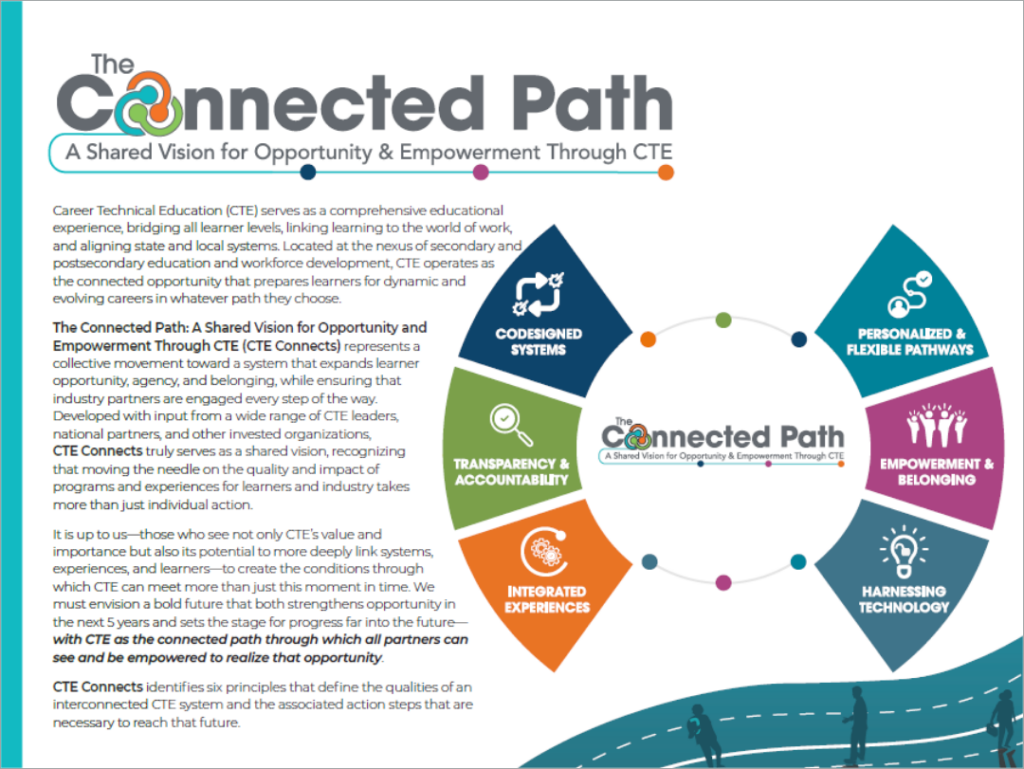
A short, two-page summary of CTE Connects that outlines each principle and the accompanying action steps.

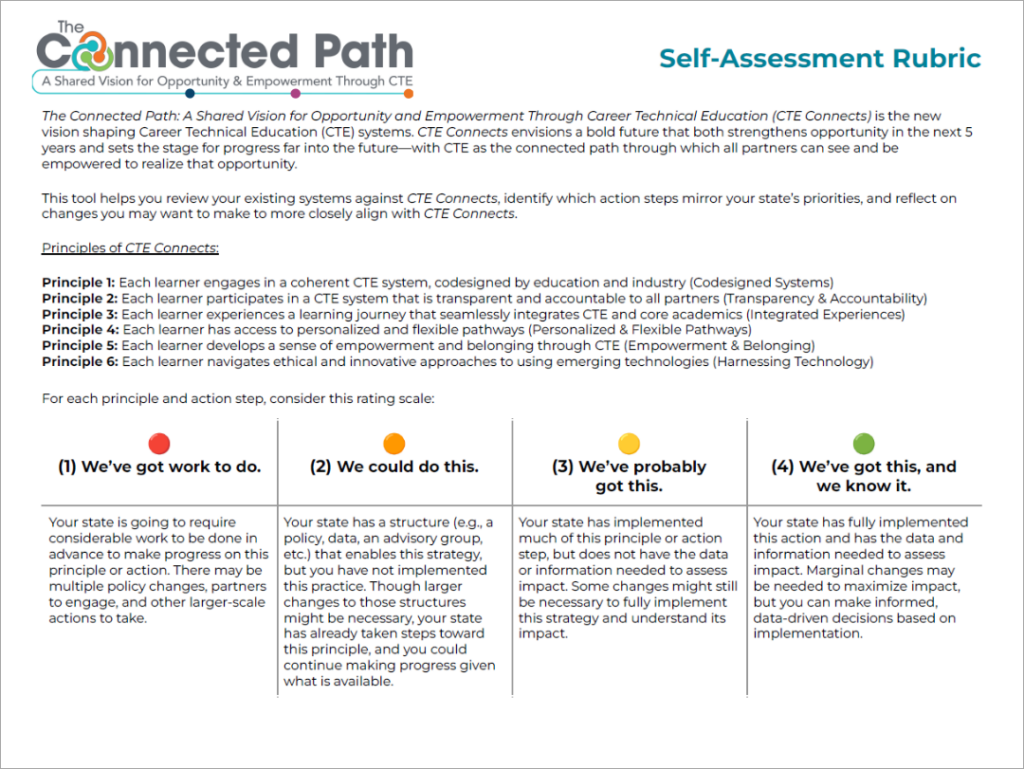

Principle 1: Each learner engages in a coherent CTE system, codesigned by education and industry.
Emerging Sectors, Responsive Career Pathways: Bridging Education and Industry shares promising practices, strategies, and actions to strengthen connections between education and industry, align systems, and engage employers.
Systems Alignment Through the National Career Clusters Framework provides considerations and recommendations to leverage the modernized National Career Clusters Framework® to develop an aligned statewide talent strategy and standardize a common language across partners that unifies systems.

Principle 2: Each learner participates in a CTE system that is transparent and accountable to all partners.
Making Career Readiness Count: A 2025 Update provides trend data, state examples, and considerations to highlight the value of publicly accessible data and strategically use career-ready indicators in federal and state accountability systems.
CTE Goal-Setting Tool (Excel Template) is a customizable tool with instructions, filters, heatmaps, and more to support the Comprehensive Local Needs Assessment (CLNA) process and CTE goal-setting that leverages existing data to center learner outcomes.

Principle 3: Each learner experiences a learning journey that seamlessly integrates CTE and core academics.
Integrating Academic and Career Technical Education: A Choice Multiplier for College and Career Readiness provides state examples and considerations across three priority areas to dismantle the silos between academics and CTE in policy and practice.
Connected Career Advising: Maximizing Capacity and Coherence for Statewide Impact provides foundational concepts, tools, and promising practices to develop and strengthen connected career advising systems.

Principle 4: Each learner has access to personalized and flexible pathways.
Flexible Career Pathways Through the National Career Clusters Framework serves as a model for program flexibility, policy, recommendations, and considerations to modernize pathway design that aligns with industry needs.
Educator Credentialing Through the National Career Clusters Framework provides processes and strategies to create more flexible policies for educator credentialing and effective professional development.

Principle 5: Each learner develops a sense of empowerment and belonging through CTE.
Leveraging Learner Voice in CTE: Empowering Learners, Enhancing CTE shares promising practices from five states to meaningfully engage learners in CTE program improvement, enhancing learner leadership and agency in CTE.
Effectively Communicating CTE to Engage Every Learner: A Recruitment and Engagement Tool provides a step-by-step process to partner with learners and families to create more effective recruitment and program communications for all learners.

Principle 6: Each learner navigates ethical and innovative approaches to using emerging technologies.
Applied Co-Intelligence: Preparing Career & Technical Education Learners for an AI-Driven Workforce provides frameworks and policy considerations to build industry-aligned artificial intelligence (AI) mastery, integrate emerging technologies ethically, and prepare learners for an AI-driven workforce.
