When it comes to CTE program improvement, are the learners who experience the system daily helping to shape it? Put another way, do learners inform your CTE systems? The very systems that learners are encouraged to participate in and complete successfully, guiding them to transition into the workforce.
If end users are not at the table, shaping the design of the system, for whom is the system being designed?
Advance CTE is exploring ways to meaningfully center learners in state and local systems change by leveraging existing structures and processes within agencies and institutions, and by including learners as co-creators in CTE programs and policies.
The practice of leveraging learner voice in CTE is essential for ensuring that CTE experiences meet learners’ needs, help them feel supported and succeed, and address all available opportunities. This practice can inform efficient decisionmaking that can promote success and mobility for learners as they experience CTE programs.
Just as CTE leaders across levels work with industry – sourcing feedback, analyzing data, and sharing insights – learners can too, offering critical feedback that impacts their lived experiences in CTE.
In a recent publication, Advance CTE, in partnership with the Kentucky Student Voice Team, the Kentucky Department of Education, and Fayette County Public Schools, elevated a pilot of leveraging Youth Participatory Action Research (YPAR) in CTE. This blog, featuring an exclusive Q&A with learner researchers from the pilot, provides insights to guide CTE leaders at all levels in turning on the light with CTE improvement: engaging learners, and listening to their wisdom and feedback for more effective CTE.
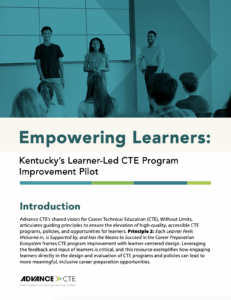
What: A pilot exploring how Youth Participatory Action Research (YPAR) can improve CTE.
Who: Advance CTE, Kentucky Department of Education, Kentucky Student Voice Team, Fayette County Public Schools.
How: High school students conducted research about their CTE programs and shared findings with decisionmakers.
Why: To center learner voice in CTE policy and program development.
Q&A with Learner Researchers
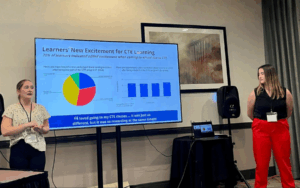
As part of the Kentucky Learner-Led CTE Program Improvement Pilot, Kaylee and Reid played central roles as youth researchers, investigating the quality of their CTE programs and presenting their findings to educators, school leaders, and policymakers. Now in college, they continue to lead in education, advocacy, and public policy. In the conversation below, they reflect on their experience, the impact of learner leadership, and their message for CTE leaders across the country. Kaylee and Reid answered some questions about the experience and why they believe learner voice is essential in CTE decisionmaking.

Reid
High school senior at the time of the pilot; now a sophomore at Denison University studying Education and Public & Political Affairs

Kaylee
High school senior at the time of the pilot; now a freshman at the
University of Kentucky studying Middle Level Education
About the Experience
If you could sit down with a group of CTE leaders from across the country, what would be helpful for them to understand about learner voice?
“Even though we are students and are still learning, so are they [CTE leaders]. Our voice just carries a different perspective—and sometimes carries more value in CTE since we are the ones within the program.” – Reid
“Learners’ voices are so important to get input, and we are trying to help out no matter what part we play.” – Kaylee
What’s something adults (teachers, principals, state leaders) often misunderstand about learners or learner leadership?
“Some adults don’t realize how much we see and how much our voices matter—and can be impactful on their classrooms and their schools.” – Kaylee
“I never had an issue with this because my teachers and others worked with me and respected me like a peer.” – Reid
What made you feel trusted and respected as a researcher in this project? What could other adults do to build that same trust with learners?
“I was given a lot of autonomy by my school. It gave me the confidence to continue with the research and help lead this project. My school leadership helped push me into finding my voice.” – Reid
“I loved [Tate’s] Creek and always felt very blessed for the support around me. Even at Advance CTE’s Fall Meeting in 2024, I felt respected—like I was an adult colleague.” – Kaylee
What would you say to a school or district that’s unsure whether students are ‘ready’ for this kind of leadership work?
“Try it out. Some students just need the opportunity to be leaders—and if it doesn’t work, it can always be a lesson.” – Reid
Reflections on Impact
How did participating in this project change how you see your role in your school, community, or future career?
“I found my love for advocacy in this project, which has helped me pick my major and future career. I realized I want to work in policy—focusing on educational advocacy and workforce.” – Reid
“It definitely changed how the staff and teachers saw me—I was recognized more. I even got to do a senior spotlight about my role in the school, which was awesome.” – Kaylee
Did being part of this research make you think differently about the purpose of school or what school could be? Should all schools offer opportunities like this?
“I think it would be a great senior research project if it were mixed in with a curriculum. It was definitely a lot on top of other classwork, but students should have the opportunity to be part of this kind of research—or at the very least, have their voices heard.” – Reid
Reid and Kaylee’s reflections show how much learners notice, how deeply they care, and how ready they are to lead. Their feedback offers perspective and provides actionable insight that can improve CTE systems. When trusted, learners step up.
Where Are They Now?
What are you doing now—school, work, other projects?
“I’m going to be a freshman at the University of Kentucky, majoring in Secondary Education – English. I’m also working at Bella Notte!” – Kaylee
“I’m heading into my sophomore year at Denison University, double majoring in Education and Public & Political Affairs. This summer, I’ve been working as a public policy intern with the Lexington Chamber of Commerce, focusing on workforce pipelines for academy students and other projects for the Chamber.” – Reid
Did this project impact your college or career choices, or how you think about your future?
“This project just made me even more want to work in the education field and make students’ voices heard.” – Kaylee
“Absolutely—it helped me realize I want to work in policy focused on educational advocacy and workforce. It really shaped my future path.” – Reid
Are you still involved in any education, policy, or youth leadership work? If so, how?
“Yes! I’ve been presenting about our school to leaders in Fayette County Public Schools, and I’ll be going to a school board meeting in August.” – Kaylee
“I’m still very involved with education advocacy through my college and internships. My capstone project is already underway—it focuses on educational equality in the U.S. compared to other countries. I’m constantly learning and advocating for how education can create a better society.” – Reid
Turn on the light. When learners are co-creators, you’re not building in the dark—you’re building a system that values and centers the end-users.
Just like anything else, meaningfully engaging learners in CTE improvement requires dedicated space, time, and a willingness to disengage from making assumptions and root firmly in informed exploration. To begin the journey of leveraging learner voice in CTE, Advance CTE offers the following resources and opportunities:
- Empowering Learners: Kentucky’s Learner-Led CTE Program Improvement Pilot – Read the complete case study.
- Leveraging Learner Voice in CTE: Empowering Learners, Enhancing CTE – Explore strategies, actions, recommendations, and models for leveraging learner voice across state and local levels.
- With Learners, Not for Learners: A Toolkit for Elevating Learner Voice in CTE – Get tools and templates to elevate learner voice.
- Explore technical assistance from Advance CTE – Let’s talk about how we can support your team.