Work-based learning (WBL) is increasingly recognized as an essential component of a high-quality Career Technical Education (CTE) pathway. As states expand access to internships, apprenticeships, and other workplace experiences, a critical question is emerging: How can states know whether learners are actually receiving a high-quality WBL experience, and how can they use that information to improve?
Historically, state approaches to WBL have often focused on defining experience types and tracking participation. For instance, a learner may need to complete a certain number of hours in their WBL experience to receive course credit or a credential. These measures remain important and document exposure to real-world experiences that cannot be taught in a classroom setting. However, participation alone cannot tell state, district, or school leaders whether learners are gaining meaningful skills, receiving appropriate support from WBL supervisors, or accessing experiences that intentionally connect to their educational and career goals. Research is also mixed on the appropriate length of time that learners should engage in a WBL experience to yield the most value, creating a lack of understanding of the importance of experience duration.
Many states have already established definitions or standards for high-quality WBL. The next challenge is determining what evidence can show whether those standards are being met. Some elements of quality definitions, such as participation and hours, can be captured relatively easily through existing data systems. Others, such as the quality of mentorship, skill development, social capital, and learners’ perceptions of their experiences, are more difficult to measure through traditional administrative data.
Emerging state approaches illustrate several ways leaders are beginning to address this challenge. Through effective measurement strategies, states can move beyond collecting WBL data to using it as a tool for continuous improvement, equitable access, and quality.
Turning Expectations into Measurable Evidence
Tennessee takes a comprehensive approach to defining and measuring high-quality WBL. The state defines WBL as a continuum of experiences, from career awareness and exploration to preparation and on-the-job training. Within that continuum, Tennessee identifies specific characteristics that distinguish a high-quality experience.
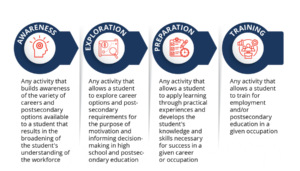
WBL Continuum from the Tennessee Work-Based Learning Implementation Guide
Tennessee also uses WBL course standards to make these expectations more concrete. Learners are expected to demonstrate transferable skills, such as applying academic knowledge, using industry-specific technical skills, and following workplace safety practices. Personalized Learning Plans and learner portfolios document what learners were expected to learn and what they demonstrated through their experiences.
 Through the Launch Pathways initiative, Tennessee is building on this foundation by exploring how to define and measure the learner experience and value of WBL through three interconnected elements: Support, Training, and Relevance. The state has taken a particular interest in the extent to which learners build meaningful relationships, receive career guidance, and participate in experiences aligned with their identified career pathways and future goals, as stated in their High School and Beyond Plan.
With support from Launch partners Education Strategy Group (ESG) and Advance CTE, Tennessee is also exploring how to measure these elements. For example, statewide learner surveys may help assess the Support element by examining learners’ development of social capital, including the number and strength of professional connections they build through WBL, whether they feel they could turn to those connections for future advice and career guidance, and their reported self-efficacy in building and using professional networks.
The Tennessee Department of Education is also partnering with TN SCORE to pilot the new framework, using the pilot to stress-test and refine the evaluation system before full-scale implementation. While this work is still evolving, it illustrates how states can begin experimenting with new ways to capture aspects of quality best understood through learner, employer, and educator experiences.
Using Certification to Verify Quality
Virginia offers another approach through its High-Quality Work-Based Learning (HQWBL) Checklist. School divisions use the checklist to document experiences that may count toward graduation requirements and Virginia’s 3E Readiness Framework.
The checklist establishes concrete criteria for quality. Experiences must include:
- Sustained interaction with industry professionals or postsecondary subject matter experts in a high-demand field
- Application of CTE coursework in a real-world setting
- Opportunities to develop Virginia’s 5 Cs
- Feedback and guidance through industry mentorship and supervision
The state also looks for opportunities for learners to earn a credential, certificate, or postsecondary credit.
Virginia then takes these criteria a step further: HQWBL experiences undergo a certification process that uses information submitted by school divisions to confirm whether WBL opportunities meet the state’s high-quality criteria. School divisions submit information about individual HQWBL experiences through a HQWBL Certification Submission Form, with submissions completed on a per-school, per-experience basis. The Virginia Department of Education’s Office of Career and Technical Education reviews submissions on a continuous basis and communicates the submission status to the CTE administrator or designee. VDOE also provides related tools, including learner evaluations, training agreements, and other resources to document the experience.
This creates a state-level quality assurance process: rather than treating every reported WBL experience as equivalent, Virginia reviews whether individual experiences meet established quality criteria before recognizing them as HQWBL.
Looking at the Bigger Picture
Colorado assesses the conditions that support quality WBL at the community or program level through its Thriving Work-Based Learning Community Assessment Guide.
The framework assesses progress across four stages—Exploring, Emerging, Demonstrating, and Thriving— including progress in evaluation and continuous improvement. At the Exploring level, programs define and consider process outcomes. As they progress, they establish system-level outcomes and indicators, then move toward regularly tracking and reporting on multiple indicators. At the Thriving level, partners regularly review indicators, publicly report progress, and use surveys to identify opportunities for improvement.
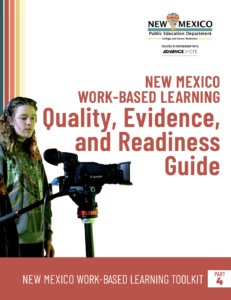 New Mexico’s WBL Readiness Assessment, developed by NMPED and Advance CTE, takes a similar approach. The assessment helps local leaders assess their WBL systems, identify gaps across the continuum, and use the results to guide planning and continuous improvement. Across these approaches, we see another way states and communities can think about WBL quality: by looking beyond individual learner experiences to the systems that make high-quality experiences possible, including whether those systems have clear, established outcomes; consistently defined and collected data indicators; and processes for using data to continuously improve.
What Does This Mean for States?
Measuring WBL quality requires states to move beyond a single participation measure. Hours and enrollment can tell states whether learners are participating. Quality measures can help answer the harder questions: Was the experience connected to the learner’s goals? Did the learner successfully apply academic or technical knowledge? Did the learner receive meaningful mentorship and feedback? Did the learner develop new skills or professional connections? And what evidence shows that those outcomes occurred?
Collecting this information will not always be easy. Some aspects of WBL quality are difficult to capture through existing administrative data systems, and states may need to invest additional time and resources to collect information directly from learners, employers, or educators. But difficulty should not prevent experimentation.
States can pilot learner surveys, test new collection methods, incorporate quality indicators into dashboards, or use certifications and recognition to encourage stronger documentation and measurement. Not every approach will be ready for statewide implementation, but experimentation can help states determine which measures provide the most useful information and which collection methods are feasible.
By defining quality, collecting evidence showing whether quality is being achieved, and using that information to identify opportunities for improvement, states can better understand the experiences learners are actually receiving and work toward ensuring every learner has real and meaningful access to proven high-quality WBL.
What’s Next for Advance CTE?
In partnership with Britebound, Advance CTE has embarked on the National Work-Based Learning Alignment Project to build a WBL taxonomy, looking at dimensions like skill attainment, duration, employer engagement, and other elements of quality programs. Once completed, this taxonomy should help states build confidence in the value and purpose of aligned experiences and drive quality measures beyond counts of hours and learners participating. Stay posted for updates and how to further participate in these efforts.