As we close this chapter of the New York Postsecondary State CTE Leaders Fellowship at Advance CTE sponsored by ECMCF (NY Fellowship), I find myself reflecting not only on what we accomplished, but on what this work signals for the broader Career Technical Education (CTE) field.
This penultimate blog in the New York Postsecondary State CTE Fellowship series offers a closeout perspective, one grounded in systems leadership, sustainability, and the urgency of building strong leadership pipelines in CTE. As a senior advisor at Advance CTE, National Fellowship lead, and coach for the NY Fellowship, I had the privilege of witnessing firsthand how a national model can be thoughtfully adapted to meet state-specific needs, while strengthening the broader ecosystem in the process.
Why the Fellowship Was Needed
The launch of the pilot In-State Fellowship, modeled after the national Postsecondary State CTE Leaders Fellowship at Advance CTE sponsored by ECMC Foundation, was not just an expansion effort. It was a strategic response to pressing challenges in the current national CTE landscape.
One of the most significant issues is leadership turnover. The 2025-2026 enrollment of 11 State CTE Directors in Advance CTE’s New State Director’s Institute (NSDI) marked an 83% increase from the 2024-2025 cohort, telling us that states are navigating rapid transitions at the very moment when CTE is central to national conversations about workforce readiness, economic mobility, and talent pipelines.
Simultaneously, governors, legislators, and workforce leaders across the country are placing unprecedented attention on career readiness initiatives. States are being asked to deliver stronger outcomes, tighter alignment with labor market demand, and increased access to high-skill, high-wage, in-demand careers.
Leadership stability and succession planning are no longer “nice to have.” They are foundational.
The NY Fellowship was designed to meet this moment.
Adapting a National Model for State Impact
Advance CTE’s National Fellowship model is rooted in systems thinking, cross-sector alignment, and applied leadership development. But effective replication requires adaptation, not duplication.
In New York, we worked intentionally to customize the model to align with state priorities. The Fellowship created space for administrators and leaders to:
- Focus on the development of systems that expand access to high-skill, high-wage, in-demand careers
- Strengthen alignment across secondary, postsecondary, and workforce systems
- Build a cohesive leadership lens beginning at the institutional level and informing state strategy
- Translate policy into implementation through strategic planning centered around access
Rather than focusing solely on theory, the Fellowship emphasized application. Fellows engaged in structured problem-solving around real state challenges, received coaching support, and tested ideas within their own institutions and agencies.
A customized workshop design allowed the experience to reflect New York’s policy environment, demographic context, and economic priorities. This flexibility was critical. States vary widely in governance structures, funding models, and stakeholder relationships. The strength of the model lies in its core framework, but its impact depends on thoughtful localization.
Five Lessons for Strengthening CTE Leadership Development
As I reflect on the Fellowship’s closeout, several insights stand out for other states and national partners considering similar efforts:
1. Leadership Pipelines Must Be Intentional
Turnover is inevitable. Preparedness is not optional. States must invest in structured leadership development models that anticipate transitions and cultivate emerging leaders before vacancies occur.
2. Leaders Must Intentionally Foster Cross-Sector Alignment
Bringing legislative, workforce, and education leaders into a shared learning experience breaks down silos and accelerates collaboration. Alignment is built through sustained engagement—not one-time convenings.
3. Customization Drives Relevance
National frameworks are essential, but their impact depends on contextual adaptation. The customized workshop design in New York ensured the Fellowship addressed real state priorities rather than abstract concepts.
4. Access Requires Structural Change
Improving access for all learners demands more than outreach efforts. It requires examining funding models, program approval processes, data systems, and accountability structures.
5. Mentorship Multiplies Impact
Connecting emerging leaders with experienced state and national mentors strengthens confidence, builds networks, and accelerates implementation.

Scaling What Worked
The close of this pilot does not signal an ending, it marks a transition.
The New York State Association for Career and Technical Education (NYSACTE) plans to continue offering the Fellowship, leveraging the resources, and frameworks developed through this initial cohort to sustain the network of leaders already cultivated, expand the ecosystem, and address emerging barriers for all learners in the state.
Scaling what worked means preserving the Fellowship’s core elements:
- Structured leadership development grounded in systems thinking
- Cross-sector representation
- Applied strategic planning tied to access goals
- Expert review and mentorship
- Customization aligned to state priorities
But scaling also requires evolution. As workforce demands shift, as technology reshapes industries, and as demographic patterns change, leadership development models must remain responsive.
A Personal Reflection
Serving as coach for the NY Fellowship has reinforced a belief I have held throughout my career: sustainable CTE systems are built on people.
Policies matter. Funding matters. Data matters. But leadership that is prepared, aligned, and serves all is what transforms strategy into impact.
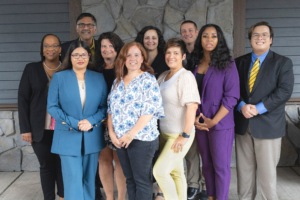
The 10 fellows who completed this experience represent a strengthened leadership pipeline for New York. They carry with them a shared language, a strategic vision, and a network that will continue to shape CTE policy and practice across the state.
If the national field is serious about advancing career readiness and economic mobility, we must be equally serious about investing in those who lead the work.
The New York pilot demonstrated that when a national model is thoughtfully adapted and when cross-sector leaders are brought together, meaningful systems change is possible.
The story of this Fellowship is not just about one state. It is about what becomes possible when we intentionally build the leadership infrastructure our field requires.
And that work, strengthening leadership pipelines in CTE, must continue. In the final post of this series, Tanner Thompson and Dr. Cynthia E. Thomas will reflect on how relationships and community strengthened the cohort and carried the work forward.
Interested in developing your own CTE leadership fellowship in your state? Please contact Dr. Kevin R. Johnson Sr. at [email protected].