
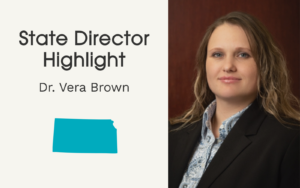
Dr. Vera Brown serves as director for Career Technical Education (CTE) at the Kansas Board of Regents, where she works to strengthen Kansas’s CTE system from the classroom to the workforce.
What was your professional journey to becoming a State CTE Director? Did any particular interest or passion fuel your career path? Why are you passionate about CTE?
I often describe my journey into CTE administration as a series of unfortunate events—the kind that, against all odds, turns into a story with a great ending. Or perhaps more accurately, a great beginning.
Unlike many CTE administrators, I did not arrive here with a direct background in career and technical education. CTE was not an obvious choice for me; it quietly, persistently drew me in. What caught me was its undeniable power to change learners’ lives quickly, tangibly, and for the better. In my seven years at the Kansas Board of Regents, CTE has become both my anchor and my passion.
The path that led me to grant management and eventually to CTE is, on the surface, fairly disjointed. As an international exchange student attending an American college, I fully expected to become an English language translator. But when it came time to choose a track in my English program, not knowing the finite facets of course catalogs and syllabi (and still relying heavily on a dictionary—yes, the actual book kind), I made what felt like an accidental decision: I enrolled in courses that sounded adjacent to translation—Technical Editing and Professional Document Design. I had no idea that this small, pragmatic choice would quietly set the foundation for my future and eventually tie me to the world of CTE.
Those first courses captivated me. Technical language was precise, purposeful, and immediate. It took abstract ideas and made them concrete. It explained how things worked—and why—right when that knowledge mattered most. In hindsight, it mirrored what I would later come to love about CTE itself: CTE is timely, practical, and powerful. And if you’re wondering—yes, I am absolutely the person who would have enjoyed writing the manual for your refrigerator. Today, I get to do something even better. I help ensure that skilled technicians are trained to manufacture it, install it, and fix it. I get to move beyond description and documentation. I get to help make it happen.
From there, my journey wandered—in the best possible way. I minored in business administration, spent several meaningful years teaching, worked in admissions and advising, wrote and managed grants, and earned a master’s degree, and an interdisciplinary Ph.D. Each role added a layer of understanding and reinforced a belief that had been quietly forming all along: CTE is more than a vocation, and more than a career pathway. It is a calling. So when the Workforce Development Unit at the Kansas Board of Regents needed a workforce specialist—and later an associate director, and eventually a director for CTE—I was ready to answer that call.
And this is where the story truly begins.
Together with colleagues across Kansas, Adult Education programs, the Kansas Department of Commerce, the Kansas Department of Labor, the Kansas State Department of Education, and other partners, we are building something larger than any one program or institution. We are shaping an effective ecosystem—one that brings together learning, industry, data, and student support. A system designed not only to respond to workforce needs, but to transform lives.
What began as a series of unfortunate events has become the work I was meant to do. And we’re only getting started.
What do you consider to be 2-3 areas of expertise for you in CTE policy/practice?
Alignment between Adult Education and Perkins-funded programs has been at the forefront of my work in the past year. Kansas has intentionally aligned AEFLA (WIOA Title II Adult Education) and Carl D. Perkins Career and Technical Education Act (Perkins V) Career and Technical Education to create seamless career pathways for adult learners. By situating Adult Education programs within or in close partnership with community and technical colleges, Kansas enables learners to move efficiently from foundational skills—such as literacy, English language acquisition, and high school equivalency—into Perkins-supported technical programs that lead to industry-recognized credentials. This alignment is operationalized through Integrated Education and Training (IET), Accelerating Opportunity Kansas (AO-K), career pathways, and emerging Workforce Pell initiatives, ensuring adult learners have access to high-demand careers and postsecondary opportunities statewide.
A key strength of the Kansas model is its coordinated approach to implementation, funding, and data. AEFLA and Perkins partners collaborate through braided funding strategies. We maximize resources while maintaining program integrity, with Adult Education supporting foundational instruction and student services and Perkins funding technical instruction, equipment, and labs. Joint planning, shared performance measures, data sharing, and regular statewide coordination—such as annual cross-program training and braided grants—reinforce accountability and continuous improvement. A strong AEFLA–Perkins collaboration can build an integrated workforce education ecosystem that supports student success, meets employer needs, and strengthens the state’s talent pipeline.
Brag about a stat that shows the success of CTE in your state. Why is it an important milestone for elevating CTE?
I’m really proud of the post-program placement results for Kansas CTE concentrators. At both the secondary and postsecondary levels, Kansas has been consistently above 90 percent for the past several years, and we continue to focus on maintaining and improving those outcomes. These results are truly a credit to our school districts and colleges, who do the hard work every day to support learners and help them succeed. I’m very grateful for their commitment and collaboration. Our workforce partners and employers deserve a great deal of credit for working closely with state agencies and our education system to support growth and opportunity across the state. Our universities also play an important role by helping technical professionals continue their education, and those pathways are reflected in our placement results as well.
To me, placement success is one of the clearest signs that our work is making a real difference. When students move directly into jobs, it shows the positive impact CTE has on individuals, families, and communities.
Thank you for letting me brag a little—it’s not often you get to say that reaching a 100 percent performance is a concern. That’s a pretty great problem to have.
Share something fun and/or personal about yourself!
Most recently, that familiar pattern of unexpected discovery surfaced again—this time underwater. I became a certified SCUBA diver, something I never planned to do and didn’t even realize I would enjoy. What began as a spontaneous experience quickly became a powerful reminder of how much exists beneath the surface, waiting to be explored.
Diving has given me a new perspective—one that closely mirrors how I approach my work in CTE. Beneath routines and processes, there is complexity, beauty, and purpose. Every dive reveals something different: shifting light, unfamiliar environments, and encounters that challenge your assumptions. Even an eel has its own quiet elegance—especially when it’s swimming away rather than directly at your face. I haven’t encountered a shark yet, but when I do, I’m sure that experience will come with its own lesson.
What surprised me most is that I don’t want to stop here. I’ve already set my sights on becoming an advanced diver and exploring new dive environments—deeper waters, different conditions, unfamiliar terrain. Much like my journey into CTE, SCUBA has reminded me that growth often comes from saying yes to the unexpected, leaning into uncertainty, and trusting that what lies beneath the surface is worth discovering. And, as with CTE work, I have a feeling I’m still very much at the beginning.