
News Summary
- The new shared vision for Career Technical Education, CTE Connects, was developed with input from over 200 national, state, and local leaders across education and work and supported by 40 national organizations.
- CTE Connects provides a roadmap to reimagine the partnership between education and employers to expand learner opportunity, agency, and belonging, while ensuring that industry partners are engaged every step of the way
- The vision focuses on six priority areas to connect education and industry to improve career readiness nationwide: codesigned systems, transparency and accountability, integrated experiences, personalized and flexible pathways, empowerment and belonging, and harnessing emerging technology.
Oxon Hill, MD – May 1, 2026 – Located at the nexus of secondary and postsecondary education and workforce development, Career Technical Education (CTE) is the true connector – connecting learners with good careers in high-skill, high-wage, and in-demand fields and employers with the talent they need. To keep pace with rapidly changing workforce, CTE must continue to be a known, trusted partner for learners and employers alike, providing a clear and connected path for success at every stage of a career journey, from the earliest grades to reskilling and lifelong learning.
Charting a Connected Path
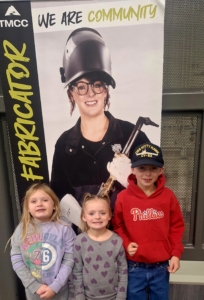
Heather’s children posing with her poster at Truckee Meadows Community College
Heather Morton enrolled in Truckee Meadows Community College seeking options and financial security as a mom of three. She learned about the school’s CTE offerings and eventually landed on welding and education instruction, “I was obsessed — it was like someone made the program for me. I don’t just have a job, I have a career. And now that I have CTE behind me, I keep adding these [tools] into this imaginary backpack.”
Heather’s chance discovery of CTE is a too familiar story. What would it look like for Heather to know about CTE in middle school, with support through and beyond high school graduation to graduate college with a welding apprenticeship? Or even blend welding and teaching coursework together to pursue a career as a welding instructor?
This requires strengthening existing experiences to deliver better outcomes, allowing CTE to offer a connected and supported path of career exploration and preparation experiences, whenever and however best meets both learner and industry needs.
A new shared vision for CTE provides the roadmap to bring that belief one step closer to reality.
Advance CTE, the national organization that supports state CTE leaders, unveiled The Connected Path: A Shared Vision for Opportunity and Empowerment Through Career Technical Education (CTE Connects) at its annual Spring Meeting just outside of the nation’s capital. This vision, CTE Connects, was developed with input from more than 200 national, state, and local industry, CTE, and career readiness leaders. It is backed by 40 national education, career readiness, and workforce organizations.
“Connecting the education and industry systems that support learners throughout their career journey is ambitious, but is absolutely necessary to keep pace with changing workforce needs,” stated Advance CTE Executive Director Kate Kreamer. “I’m very grateful for the strong commitment and confidence from our members and national partners. With CTE Connects, Career Technical Education can not only take the lead in creating a connected path for lifelong learning, but make its programs the difference maker for learners to gain economic mobility in an ever-changing world.”
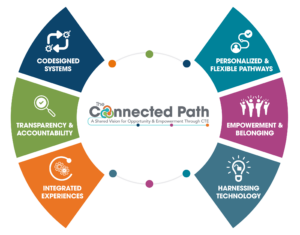
Priorities for the Future
The vision centers on six principles that serve as priority areas for action to improve the learner experience in CTE:
- Codesigned Systems: Each learner engages in a coherent CTE system, codesigned by education and industry.
- Transparency & Accountability: Each learner participates in a CTE system that is transparent and accountable to all partners.
- Integrated Experiences: Each learner experiences a learning journey that seamlessly integrates CTE and core academics.
- Personalized & Flexible Pathways: Each learner has access to personalized and flexible pathways.
- Empowerment & Belonging: Each learner develops a sense of empowerment and belonging through CTE.
- Harnessing Technology: Each learner navigates ethical and innovative approaches to using emerging technologies.
When implemented, these principles can guide conversations and actions for a wide range of policies and programs that impact CTE and the future of work — learner retention and engagement, work-based learning and apprenticeships, credentials of value, career advising, Workforce Pell, and instructor supports. Each vision principle includes actions that go from the big picture to tactical next steps to guide implementation .
Harnessing The Power of Connection
Supporters of CTE Connects highlight the power of a shared, national vision to provide urgency and a clear direction to create systems that remove silos and create a connected path of systems that center the learner experience, reimagine partnership across learner levels and sectors, leverage technology effectively, and strengthen outcomes for all.
“There is so much great news coming out of Career Technical Education right now about its value for learner engagement, readiness for college and the workplace, and sourcing for reliable talent pipelines for employers”, stated Thalea Longhurst, Utah State CTE Director and President of the Advance CTE Board of Directors. “This vision serves as the catalyst to address what we all know — education and industry must work together better to give learners the high-quality experiences they deserve. That means we need systems at the state level that bring together the expectations, language, data, and needs of both.”
The Path to Realize CTE Connects
“This vision lays the groundwork to shape the future of CTE and career readiness not just for the next five years, but the next 25 years,” emphasizes Kreamer. Advance CTE plans to support the field in making progress towards this vision at all levels. This will range from national initiatives that build common work-based learning definitions and implement the modernized National Career Clusters Framework; direct support to states to design system connections and improvements across credentials of value, postsecondary data, and more; to providing resources to scale new innovations from local educators and employers.
Jason Tyszko, Senior Vice President of the U.S. Chamber of Commerce Foundation, views the vision as a key conversation starter that can bridge connections between systems. “These six principles give employers and education partners straightforward, concrete policy guidance to find common ground when having conversations on how we can improve connections across systems. That can be how to share data, create common language, align standards for how we measure skill readiness — the possibilities are limitless.”
Full information and resources for CTE Connects can be found at: www.careertech.org/cte-connects
####
Advance CTE is the longest-standing national non-profit that represents State Directors and state leaders responsible for secondary, postsecondary, and adult Career Technical Education (CTE) across all 50 states and U.S. territories. Established in 1920, Advance CTE supports state CTE leadership to advance high-quality CTE policies, programs, and pathways that ensure career and college success for each learner.
