
As the electric vehicle (EV) industry expands at a rapid pace, states, employers, and education leaders are grappling with a critical question: how do we build a workforce system capable of quickly responding to the industry’s evolving talent needs? Across the country, community colleges and employers are stepping up to that challenge by building more connected, responsive systems and including Career Technical Education (CTE) as a key connector.
EV careers cover a wide array of industries. The graphic below, produced by Advance CTE, organizes key industries through Cluster Groupings via the National Career Clusters® Framework and highlights a variety of in-demand career paths.
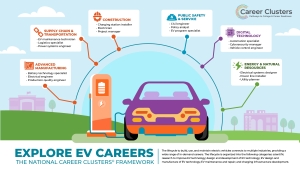
Advance CTE is a partner on a national initiative for career readiness systems alignment led by the American Association of Community Colleges (AACC), with support from the U.S. Department of Labor. This initiative strives to highlight how community colleges are emerging as critical conveners in designing and scaling EV talent pipelines, and pilot scaled pipelines through registered apprenticeships. Site visits to Kansas, Illinois, and New York highlight what that looks like in practice. While each model looks different, they share a common thread: strong workforce development happens when community colleges, employers, and K-12 partners work together to build codesigned programs with shared responsibility and investment that are aligned, adaptable, and responsive to both industry and learner needs.
The Role of Community Colleges
At their strongest, community colleges serve as workforce intermediaries—connecting employers, learners, K-12 and postsecondary systems, as well as regional workforce priorities.
Through Kansas City Kansas Community College (KCKCC) in Kansas, apprenticeship programs with Panasonic Energy Corporation of North America are built on consistent, structured communication. With a clear point of contact on both sides and regular, weekly check-ins, the program and curriculum evolve alongside employer needs.
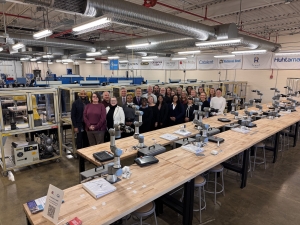
Strong employer collaboration has big dividends for learners, who benefit from pathways that are continuously co-designed with industry and aligned to real workforce needs. Learners also benefit from reduced lag between the skills taught and what’s needed by employers.
At Heartland Community College (HCC) in Illinois, the college has expanded its applied programs and strengthened ties with regional EV employers, including Rivian Automotive. As those partnerships expanded, the college evolved from a predominantly transfer-focused institution into a key regional workforce talent partner by expanding applied programs that keep learners local.
In New York, Hudson Valley Community College (HVCC) integrates EV charging and infrastructure content across automotive, electrical, and related programs, such as lineworker training. Faculty collaborate across disciplines, helping learners understand how different parts of the system connect and reflecting the reality that postsecondary pathways work best as multi-disciplinary, flexible experiences. Faculty also have access to employer-informed instructional modules that help keep the curriculum current as technologies evolve. Together, these approaches help learners build transferable technical and durable skills that can be applied across a rapidly changing industry.
Apprenticeship as Infrastructure
Across all three sites, apprenticeship is central to the delivery of training programs. These programs combine:
- Paid, on-the-job training;
- Structured technical instruction; and
- Clear pathways into employment.
Several partners also emphasized the importance of connecting apprenticeship pathways to secondary CTE and dual enrollment opportunities to strengthen early talent development.
Building Flexible Workforce Systems
Despite differences in program design, all three EV workforce models shared a defining characteristic: adaptability.
Rather than over-specializing, leading programs prioritize foundational technical knowledge and transferable skills that can move across roles, employers, and technologies. In Illinois, for example, employers emphasized building programs that prepare learners for the broader industry by focusing on foundational, transferable skills. Durable skills such as problem-solving, communication, and continuous improvement are embedded throughout training, alongside curriculum structures that allow for frequent updates as industry needs evolve.
This approach reflects a broader shift in workforce development away from static training models and toward more responsive systems that evolve alongside industry. As EV technologies continue to change rapidly, flexibility and cross-sector collaboration will remain essential to building sustainable talent pipelines.
Addressing Early Pipeline Gaps for a Connected Talent Ecosystem
The transition to an EV economy is not only a technological shift, but also a shift in how education and workforce systems prepare learners for careers.
Even with strong postsecondary and employer partnerships, important gaps remain earlier in the talent pipeline. Partners across all three sites pointed to limited awareness of apprenticeship opportunities among learners and families, challenges connecting with secondary systems, and barriers to expanding youth apprenticeship opportunities at scale.
Many learners still have little exposure to advanced manufacturing and EV careers during middle and high school, while misalignment between education systems and workforce expectations can create confusion about available pathways and the skills needed for these careers. In some cases, complex requirements for youth apprenticeship participation also make it difficult for programs to expand access.
Sites have started the work on solutions. Hudson Valley Community College, for example, engages learners as early as elementary school through its “Kids on Campus” programming, while also operating early college and P-TECH models that immerse high school students directly in college and career-connected learning environments.
At Heartland Community College, partnerships span secondary, postsecondary, and employment systems. Through collaboration with Bloomington Career Academy and Rivian Automotive, learners can progress from high school exploration to pre-apprenticeship to registered apprenticeship—helping learners transition more successfully into postsecondary education and employment.
To meet this moment, states and regions will need to continue building stronger connections across education, workforce, and industry partners, creating more consistent spaces for collaboration and shared decisionmaking. Supporting intermediary organizations can help keep this work coordinated and moving forward, while a greater focus on alignment rather than duplicating efforts can make pathways clearer and more efficient. There is also an opportunity to expand access and awareness, especially for younger learners and those who have not traditionally been connected to these pathways, so more individuals can see and pursue opportunities in the evolving workforce.
As the EV industry continues to evolve, the regions best positioned for success will be those investing not only in technology, but in coordinated talent ecosystems.