
State Career Technical Education (CTE) Directors carry a mandate that is simultaneously simple and immense: ensure every learner has a meaningful path to a high-skill, high-wage, in-demand career. But for too many learners, “career readiness” has been reduced to a single interest survey in eighth grade and a course selection form. That is career awareness — and it is a starting point, not a destination.
The difference between a learner who takes a career interest assessment and one who is genuinely career-ready is the difference between a compass and a completed journey. Connecting vision to impact means building the statewide infrastructure to take learners all the way through.
The Problem With Exploration Alone

Assessment matters. But does an assessment alone truly connect students to the workforce? Knowing one’s interests, work values, and aptitudes is foundational. But research from the CTE Research Network, led by the American Institutes for Research (AIR) in partnership with ACTE, makes clear that while CTE participation produces statistically significant positive impacts on learners’ employability skills and high school completion, those outcomes are strongest when programs are designed around the full range of career development, not just initial exploration.
An assessment tells a learner who they are. Development is what builds who they become.
The Strengthening Career and Technical Education for the 21st Century Act (Perkins V) reinforces this directly. Section 135(b)(1) requires that programs “provide career exploration and career development activities through an organized, systematic framework”—from pre-enrollment through graduation and placement. Exploration is required, but so is development. State leaders are responsible for ensuring that continuum exists at scale across every district they oversee.
A Systematic Framework for Career Readiness & Development
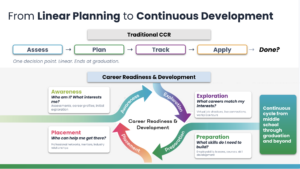
Pathful’s Comprehensive Career Readiness & Development platform is built around exactly that kind of organized, systematic framework—one that moves every learner from initial self-discovery through authentic career experiences, with administrators able to track progress at every step.
The framework is a continuous cycle—not the traditional linear model that ends at the diploma—built on four phases:
Awareness: Learners discover who they are through a comprehensive assessment suite grounded in validated instruments including the ONET Interest Profiler (RIASEC model) and the ONET Work Importance Locator, then explore all 16 Career Clusters® through videos, live professional connections, and O*NET-powered career profiles.
Exploration: Learners research specific careers and education pathways, understand skill and financial realities, and formalize a career plan with clear goals and actionable steps. This is where an assessment becomes a plan.
Preparation: Learners build skills and authentic experiences, completing industry-led projects sourced from real professionals, earning work-based learning (WBL) hours through simulated and in-person experiences, developing employability competencies through standards-aligned lessons and microcredentials, and building professional networks across every Career Cluster.
Placement: Learners develop resumes, cover letters, and portfolios; access targeted postsecondary and career opportunities; and complete capstone experiences that demonstrate comprehensive career readiness. They launch—not stumble—into the next chapter.
What Scale Actually Looks Like

Riverside Unified School District (RUSD) in California faced a challenge state leaders know well: California’s 10-year CTE Continuum Mandate required systematic career guidance across an entire district, not just for CTE concentrators. RUSD chose to make Pathful available to every learner—not only those in CTE programs—and built a 15-year continuum organized around Explore, Engage, and Experience. Today, 42,000 learners across 59 schools benefit from that system. CTE educators engage middle schoolers to establish real-world context; Pathful Junior is integrated into 30 elementary schools; and career lessons are embedded cross-curricularly across academic subjects.
As RUSD CTE Coordinator Ron Weston put it:
“We’ve really tried to make sure our teachers understand that Pathful can connect students to their careers.”
That is what connecting vision to impact looks like at scale. State CTE Directors can make it the standard.
Proving It: Data, Compliance, and Perkins Reporting
Scaling career development programming is necessary. Being able to prove it happened is essential. Advance CTE has found that 34 states now use work-based learning in their Perkins V size, scope, and quality definitions, with more than half of states counting WBL within their accountability systems. The documentation burden on CTE administrators is real and growing.
Pathful’s Jobready360 suite closes the gap between what learners are doing and what leaders can prove. JobreadyCTE tracks competencies aligned to state standards, manages accreditation and audit evidence, and generates pre-built reporting templates aligned to Perkins, NATEF, and NIMS frameworks. JobreadyWBL provides end-to-end WBL management—digital forms, employer clearances, mobile hour tracking, and site visit documentation, all available year-round in real time—replacing the spreadsheets that make compliance a full-time burden. Together, they deliver the disaggregated, export-ready data that supports Perkins V core indicator reporting, state strategic plans, and analysis of access and outcomes across every learner population.
The Statewide Imperative
State CTE Directors are responsible not just for the quality of individual programs, but for the access and coherence of an entire career preparation ecosystem for all learners. Perkins V gives states the authority and the mandate to build that framework. Pathful gives state leaders the infrastructure to deploy it consistently track it rigorously, and prove impact to the legislators, workforce boards, employers, and families who need to see the return on their investment in Career Technical Education.
By Melinda Spivey, Ed.S., Vice President of Sales, Pathful; Former CTE Director, District Administrator, and School Principal
Melinda Spivey holds an Ed.S. in Curriculum and Instruction and a master’s in Educational Leadership and Administration. A former CTE teacher, principal, district supervisor, and CTE director, she has more than 25 years of experience in PK–12 and postsecondary education. She serves as Vice President of Sales at Pathful.