In 2025, 49 states enacted 172 CTE-related policies, the highest number recorded since before the coronavirus pandemic.
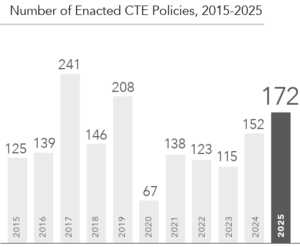
With 20 more policy enactments in 2025 than 2024, this increase reflects states’ continued commitment to strengthening CTE programs and systems through policy. This increase in policy activity was also due in part to states that operate on biennial legislative calendars having legislative sessions in 2025. One of such states, Texas, enacted 15 CTE-related policies, the highest number for any single state this year.
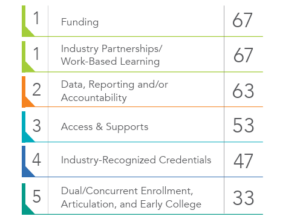
For the first time, two policy categories tied for the top spot, with 67 policy enactments each in the funding and industry partnerships/work-based learning categories. Here are the top CTE policy categories of 2025, with a state example for each.
Funding
Policies address significant changes in CTE funding, such as increasing or decreasing allocations (+/- 5% change), creating a scholarship or grant program, or investing in a pilot program.
Michigan increased the CTE reimbursement funds to school districts for vocational education programs by $1,834,000 million, bringing the new total to $41.6 million. The state also increased the CTE early middle college/dual enrollment fund by $400,000, bringing the new total to $8.4 million, and allocated a $20 million one-time student assistance fund for career education planning districts.
Industry Partnerships & Work-Based Learning
Policies address engaging industry to drive learning through work-based learning or other means.
Montana established the 406 JOBS Initiative to serve as the framework coordinating workforce development efforts across state agencies and labor, education, industry, and economic development partners. The State Workforce Innovation Board will lead the initiative in alignment with state economic priorities, facilitate strategies that reflect current and future labor market trends, and consult with Tribal and Native-led organizations, schools, and governments to implement strategies that reflect the needs of Tribal communities.
Data, Reporting, and/or Accountability
Policies address data and research activities that support CTE, including the use of labor market information and the inclusion of career readiness indicators within accountability systems.
Nevada embedded CTE into their statewide accountability and workforce‑pipeline systems. The state directed the Commission on Innovation and Excellence in Education to evaluate school performance using CTE‑specific metrics such as the number of industry credentials earned and the number of graduates who enroll in vocational, technical‑school or apprenticeship programs .
Access and Supports
Policies address removing barriers for learners from diverse backgrounds to access CTE programs, including through scholarships, targeted opportunities, and inclusive career exploration.
New Hampshire updated Regional CTE Agreements to include a formal CTE access program that allows learners from sending districts (the district, charter school, home school, or private school that a learner resides in) to enroll in both full-time and part-time CTE programs in receiving districts (the district, charter school, home school, or private school that has a CTE program).
Industry Recognized Credentials
Policies address attainment of credentials recognized by industry, including microcredentials, such as badges, and educational certificates and degrees.
Utah created the First Credential Program to enable learners to earn their first industry-recognized credential upon completion of the program. The Utah Board of Higher Education must ensure that credits earned through the First Credential Program are accepted and transferable to institutions of higher education, including technical colleges.
Dual/Concurrent Enrollment, Articulation, and Early College
Policies address postsecondary credit attainment and transfer through dual/concurrent credit attainment, credit transfer agreements, and early college programs.
Alabama required all local education agencies in the state to allow high school learners to enroll in any dual enrollment course offered by a local community college or university, as long as the course is approved for dual credit by the State Department of Education.
Advance CTE and ACTE’s policy tracking efforts culminate in the annual release of a report that offers insights on CTE policy activities observed in the previous year. The most recent iteration, the State Policies Impacting CTE: 2025 Year in Review report, offers key policy trends, top categories, and examples from various states.
Advance CTE and ACTE hosted a webinar on Thursday, March 5, 2026, to offer a deep dive into the findings and address preliminary questions. This year’s webinar will feature Texas representatives Marcette Kilgore, Director of Career and Technical Education, Texas Education Agency, and Robin Painovich, Executive Director, Career & Technical Association of Texas, who will share insights into their state’s 2025 policy activity and reflect on how enactments are translating into practice.
Click here watch a recording of the webinar. Visit Advance CTE’s State Policy Resources Page for more.