Changing systems to improve outcomes for learners can come with a lot of factors to navigate—changing administration, staff turnover, evolving statewide visions and priorities, and the variety of needs across local entities, just to name a few. So what does it take to sustain a five-year campaign to not only implement a new approach to data analysis, but also build mindsets to use the data in a meaningful way?
The Colorado Career Technical Education (CTE) state team has spent the last five years intentionally integrating Advance CTE’s Opportunity Gap Analysis (OGA) processes into its cyclical data collection and review practices at all levels of education—and their approach is showing dividends in ensuring all learners can have access to and succeed in high-quality CTE programs.
| Advance CTE’s OGA workshop gives state and institutional CTE leaders the data confidence and practical tools they need to uncover gaps and improve learner outcomes. |
Laying the Foundation
 The road to ensuring learner access began in 2021, when the CTE team from the Colorado Community College System (CCCS) participated in Advance CTE’s OGA workshops. The introductory workshops and subsequent communities of practice created a supportive environment for the state to explore how to intentionally integrate not just a gap analysis process, but aligned training and support for CTE leaders from state agencies to local schools.
For Colorado, integrating gap analysis into its Comprehensive Local Needs Assessment (CLNA), completed by all local education agencies seeking CTE funding, offered a clear path to embedding these practices into the data analysis culture.
The first step: building data literacy. The team built out intentional resources and dashboards intuitively aligned with state Carl D. Perkins Career and Technical Education Act (Perkins V) priorities, then launched widespread virtual and in-person training sessions. The response was enthusiastic, giving the state team momentum to continue building capacity.
Colorado also recognized that sustainable systems cannot depend on individual staff members and designed knowledge management records to preserve institutional knowledge.
Building the Goal-Setting Tool
Throughout 2024, CCCS’s CTE team continued to provide consistent support for local education agencies (LEAs) and institutions of higher education (IHEs) as they worked toward long-term integration of the dashboard and OGA processes into annual data reviews.
As Colorado’s understanding of its opportunity gaps deepened, the team saw an opportunity to take the work a step further: use those findings to set concrete, measurable goals to move one step closer to full access.
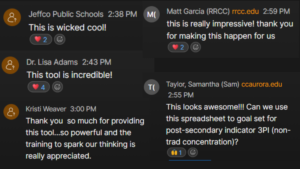
Reactions to the Goal-Setting Tool from district staff during the first Colorado Data Summit
This brought the team to Advance CTE’s Senior Associate of Technical Assistance Haley Wing to customize and integrate her CTE Goal-Setting Tool into their existing dashboards. Launching the project in late 2024 and debuting it at what would be Colorado’s first annual Data Summit, the Colorado OGA Goal-Setting tool combines gap analysis and goal setting for LEAs and IHEs to pinpoint the number of learners needed to reach established Perkins performance goals.
The tool was officially released in March 2025, generating strong interest during its introductory webinar and providing local leaders with a new way to translate data findings into actionable goals.
Statewide Rollout
Throughout 2025, the team continued introducing the Goal-Setting Tool to leaders across the state, incorporating an in-person roadshow into the CLNA process. They engaged all regions across the state—providing individual office hours, technical assistance, and in-depth principal cohorts—to bring not just CTE leaders, but also key district and college administration on board.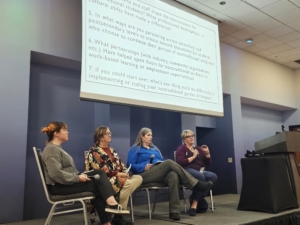
By November 2025, the team was preparing for its second annual Data Summit, which included a session on the Goal-Setting Tool and new data processes shaped in part by the recently enacted SB25-315 and HB25-1278.
These policies brought a new accountability focus to what the state calls “The Big Three”:
- College credit (i.e. concurrent enrollment) in postsecondary education options to obtain 12 credit hours by the end of a learner’s high school career;
- Attainment of an industry-recognized credential identified in the annual Colorado Talent Pipeline Report; or
- Participation in at least 60 hours of a state-approved work-based learning experience
A District-Level Perspective
Throughout this rollout, Advance CTE gave Colorado’s state team the time and space to step back from the day-to-day work. Most importantly, the Intensive cohort gave the state team an opportunity to work in tandem with Mike Burke, a district-level CTE leader, who participated in the Intensive cohort while stepping into his new role as Director of Postsecondary Workforce Readiness and CTE for District 27J.
Bringing a wealth of classroom and local experience, Mike gave perspective from his peers and his position that strengthened the technical assistance and supports being created by CCCS.
Reflecting on the experience, Mike shared:
“I felt empowered to share my thoughts and perspective as a newer leader and former building principal to help shape this work and make it usable.”
He came away with a newfound relationship with his state-level CTE team, feeling supported and heard at the district level, and appreciating the growth of his leadership skills not just within his district, but with his peers across the state.
The Impact
What began as a workshop way back in 2021 has turned into a core component of Colorado’s approach to data-driven CTE improvement, impacting local CTE educators, learners, and administrators across the state. The intentional rollout of training, consistent incorporation of OGA in annual CLNA processes, and an emphasis on creating a complete understanding of OGA and goal setting at all levels—from school boards, local-level executives and administrators, CTE leaders, and educators in and outside of CTE classrooms—has brought a collaborative spirit and effort to increasing learner access and success to high-quality CTE programs across the state.
Colorado’s journey has been supported every step of the way by the staff here at Advance CTE, and the expertise and hard work of the state-level CTE team have helped elevate CTE in conversations from the state house to the school house.
Whether your state is interested in participating in an OGA workshop to kickstart the work, or is ready to take the next step by incorporating Goal Setting, reach out via the Advance CTE Technical Assistance Request Form.
This work was led by Colorado’s CTE state team: Victoria Crownover, Associate State Director of CTE; Emily Fickbohm, Director of CTE Performance; Lori Lacefield, CTE Data Specialist; and Aimee Barker, Former Career and Technical Act Manager at the Colorado Community College System (CCCS) — alongside Mike Burke, Director of Postsecondary Workforce Readiness (PWR) and CTE for District 27J.
This work was generously supported by the Joyce Foundation.