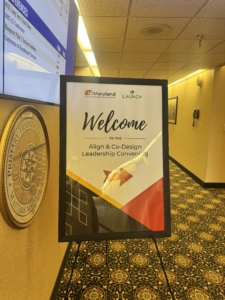
 Across Maryland, school and district leaders are advancing a bold vision: implementing Career-Connected Learning (CCL) systems and Six-Year Plans to prepare every learner for success beyond graduation. As with any systems-level change, this work requires more than launching new programs—it calls for a shift in how education systems operate. This challenge was at the heart of the recent Maryland State Department of Education’s Align & Co-Design Leadership Convening.
Maryland’s Vision for Career-Connected Learning
CCL experiences in Maryland are designed to bridge the gap between education and workforce needs. Through apprenticeships, internships, school-based enterprises, and industry-aligned capstone courses, learners earn graduation credit while gaining authentic exposure to real-world careers. The Six-Year Plan (SYP) complements the CCL system by ensuring every learner (beginning in middle school) has a personalized, evolving, and flexible roadmap that aligns coursework, exploration, and support with their unique interests and future goals.
From Program Implementation to Systems Change
While the goals are clear, the real challenge for leaders is how to lead large-scale change across interconnected teams, departments, and partners. The Align & Co-Design Leadership Convening, held as part of Maryland’s work as an Accelerator State in the Launch Initiative, emphasized reframing this effort as systemwide change, not simply the rollout of a new initiative. Leaders came together to deepen their understanding of CCL and SYP guidance and to strengthen the leadership practices required to make these systems work at scale.
Throughout the convening, leaders explored questions that shifted their focus from implementation to alignment:
- How are learners currently experiencing advising and pathways?
- How should departments, teams, and partners collaborate differently?
- How will decisions be made and shared to foster coherence across the system?
Technical vs. Adaptive Change: Why Leadership Matters
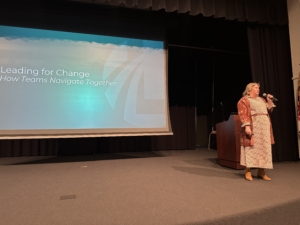 I had the opportunity to lead a change management session during the convening that helped distinguish technical work, tasks that can be assigned and often completed independently, from adaptive work, which requires new ways of working together.
While templates, tools, and timelines matter, success ultimately hinges on adaptive leadership: building shared ownership, fostering true collaboration, and making decisions that prioritize alignment over speed.
A central theme of this session was the need to shift from ownership to stewardship; cultivating a mindset of “this is ours” rather than “this is mine.” This means fostering collective responsibility for systemwide goals and outcomes, rather than limiting focus to individual departments or roles.
By moving from simple coordination to true collaboration, teams are encouraged to engage in joint problem-solving instead of merely sharing round-robin updates. Just as importantly, leaders are challenged to slow down decision-making when needed, prioritizing strategic, more unified decisions over quick answers.
Hands-On Leadership: System Mapping in Action
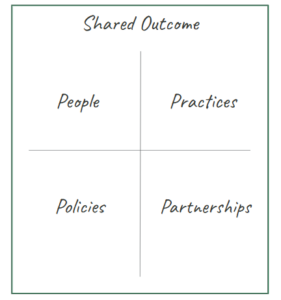 During the session, I led district leaders through a four-step systems-mapping activity:
- District leaders collaborated to establish a shared outcome: In 2-3 years, what would be visibly different for learners if CCL and SYPs were working as intended?
- Leaders engaged in a hands-on systems-mapping activity that asked: If CCL is truly systemwide, what must shift across people, practices, policies, and partnerships?
- Leaders discussed: Where does collaboration break down? Where do leadership decisions get stuck ( i.e. How will they have to lead differently?)?
- Identify a leadership move to reduce friction in this area. Examples include:
- Establish cross-department CCL meetings
- Create clear joint decision-making norms
- Share creation and monitoring of success metrics
This activity can easily be replicated for teams of various sizes to support systems change during program implementation.
Practical Suggestions for Leaders
For state education leaders and policymakers, Maryland’s approach offers actionable insights:
- Reframe the work: Communicate the shift from program implementation to meaningful systems transformation.
- Foster shared stewardship: Move from “my department” to “our system.”
- Prioritize collaboration: Replace stand-alone updates with opportunities for joint problem-solving.
- Build coherence: Value better decisions over faster answers—alignment is key.
- Strengthen system structures: Regularly identify where friction or breakdowns occur and consider the leadership moves needed to address them.
- Promote sustained commitment: Encourage leaders to reflect on one individual and one team-based practice they can change or enhance, and build time for reflection and adjustment into the project timeline (e.g., 90-day check-ins, etc.)
Leadership for Change
Maryland’s experience underscores a core truth: systemwide change is possible when leadership is shared, intentional, and sustained. The journey ahead requires courage, creativity, and commitment, but as Maryland’s educators are demonstrating, real transformation is within reach when we lead together.
To learn more about Maryland and the work being done across the Launch Initiative, follow Launch Pathways on LinkedIn
To learn more about how Advance CTE can support you and your team in managing systems change with solutions tailored to your state’s needs, visit our Customized Technical Assistance page.