What does it take to move data-driven decisionmaking from a promising practice to a standard practice? For New Mexico, it’s meant a sustained commitment to building systems, processes, and partnerships that empower local leaders to use data to improve Career Technical Education (CTE) access and outcomes.
Through participation in Advance CTE’s Intensive Opportunity Gap Analysis (IOGA) initiative, New Mexico has expanded the use of data across its CTE ecosystem, strengthened local capacity, and created sustainable structures that will continue to support learner success for years to come.
Building on Existing Momentum
New Mexico already had experience with OGA (through the OGA 2.0 Cohort in 2023), so New Mexico’s local education agencies (LEAs) were able to quickly adapt and integrate gap analysis for data-driven decisionmaking.
Through IOGA, NM LEAs got better at understanding CTE-specific data and spotting potential gaps in access to their CTE programs. The experience provided NM with the opportunity to level up data-driven analyses and continue to explore ways for the state agency to serve LEAs’ data needs.
Scaling Training and Expanding Access
NM scaled its IOGA training by adding both in-person and virtual sessions, increasing participation from 69 NM LEA participants in 2023 to over 300 OGA workshop participants in 2025.
New Mexico’s biggest win: 100% of Carl D. Perkins Career and Technical Education Act (Perkins V) grant recipients are now conducting a local OGA and embracing data-driven decisionmaking for their 2026-27 CTE application as required, after NM fully integrated the OGA process into the comprehensive local needs assessment (CLNA) for the 2025-26 academic year.
Expanding Data Access and Continuous Improvement Through IOGA
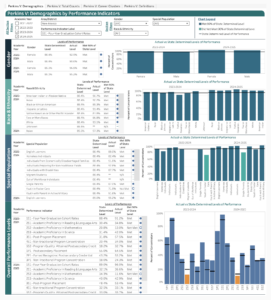
New Mexico developed a comprehensive, public-facing CTE data dashboard that provides four years of longitudinal data for all Perkins-participating LEAs. The state has also completed three years of Opportunity Gap Analysis heat maps, giving local leaders actionable data to look at learner access, participation, and performance. Analysis of the fourth year of data is underway, and this expanded dataset will enable deeper trend analyses to identify persistent and emerging opportunity gaps at both the state and local levels.
New Mexico will continue offering in-person and virtual professional learning opportunities to help LEAs effectively interpret and apply the data. What began as an exploratory initiative has evolved into a highly requested, demand-driven process for continuous improvement, with educators and administrators increasingly using data to inform CTE program planning, resource allocation, and strategies to improve learner outcomes.
Advancing Data Quality Through Cross-Agency Alignment
New Mexico has experienced significant growth in Perkins V participation. In response, the Public Education Department’s College and Career Readiness (CCR) team brought together representatives from state agencies, LEAs, and higher education institutions (HEIs) to modernize its Perkins data reporting guidance and establish a shared understanding of CTE data definitions, reporting requirements, business rules, and learner-level data linkages across agencies.
Through an iterative, cross-agency review process, partners examined every aspect of the Perkins data reporting system, including:
- data aggregation and disaggregation
- special populations
- CTE participant and concentrator definitions
- enrollment and funding terms
- Classification of Instructional Programs (CIP) codes
- nontraditional participation
- workforce engagement
- credential attainment
- calculation of numerators, denominators, reporting periods, and state-determined performance levels
They also strengthened understanding of how learner data moves through student information systems, is matched across agencies, and is incorporated into the annual federal Perkins reporting process.
This work established a common foundation for a learner-centered CTE data ecosystem: consistent definitions, cleaner data, and stronger coordination across agencies. The initiative was designed to enhance cross-agency oversight of CTE data, streamline reporting processes for LEAs and HEIs, and produce updated Perkins guidebooks that provide more accurate guidance for data reporting and continuous improvement.
Ultimately, the CCR team, in partnership with practitioners and the public, is now better equipped to put CTE data to use, connecting more learners to high-skill, high-wage, and in-demand CTE programs across every career pathway.
New Mexico’s work with Advance CTE is a strong example of what’s possible with sustained, hands-on support by experts who are dedicated to a culture of actionable, transparent, and trustworthy data in every state. If you are interested in this training or other technical assistance opportunities at Advance CTE, please reach out via the Advance CTE Technical Assistance Request Form.