Work-based learning (WBL) is having a moment. Seventy-nine percent of high school students say they would participate in work-based learning opportunities. In 2025 alone, states passed over 60 policies connected to WBL and industry partnerships.
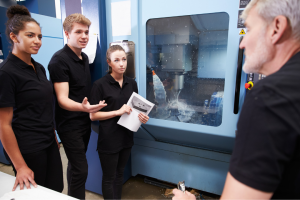 Work-based learning is popular right now because it provides authentic, real-world experiences that help learners and employers alike. Learners gain transferable skills; social capital through professional connections and mentorship; practical application of what they learn in the classroom; and experience to put on their resume.
When designed well, employers get access to future talent and direct value from these short-term employees. This all speaks to the broader trend, influenced by over a decade of investment and policy around Career Technical Education (CTE) and career readiness. As the economy shifts and uncertainty grows, the chance to build a network and real-world skills is incredibly attractive to learners, whether they have participated in CTE courses or not.
Finding My Path Through Hands-On Learning
Unfortunately, I didn’t have access to work-based learning in high school. I had afterschool and summer jobs, but I can’t call those true WBL experiences because I chose my jobs based on who hired me first, not my career interests.
What I did participate in was a service-learning project in 11th grade. We partnered with community-based organizations to put on an event for marginalized populations in the New Haven, CT area. It was transformative, and it set me on my current path toward non-profits, mission-driven work, and a focus on impact. In college and graduate school, I participated in internships that fully confirmed my passion for public policy, and education policy specifically.
WBL and CTE: The Carl D. Perkins Career and Technical Education Act, the law that funds Career Technical Education at the federal level, contains the only federal definition for WBL.
Twenty-seven states use work-based learning participation as a program quality indicator. CTE programs are expected to design their coursework to provide direct interaction with employers in the classroom, as well as hands-on experiences in the workplace.
Closing the Value Gap to Tell Work-Based Learning’s Full Story
WBL keeps growing, but with new opportunities come new challenges. You may have heard of words used for hands-on experiences with employers — apprenticeships, internships, co-ops, school-based enterprises. But what exactly do these experiences look like?
Right now, these terms mean something different in every state, with no baseline for quality or go-to data for outcomes. That makes it hard to demonstrate true impact to learners, employers, and communities.
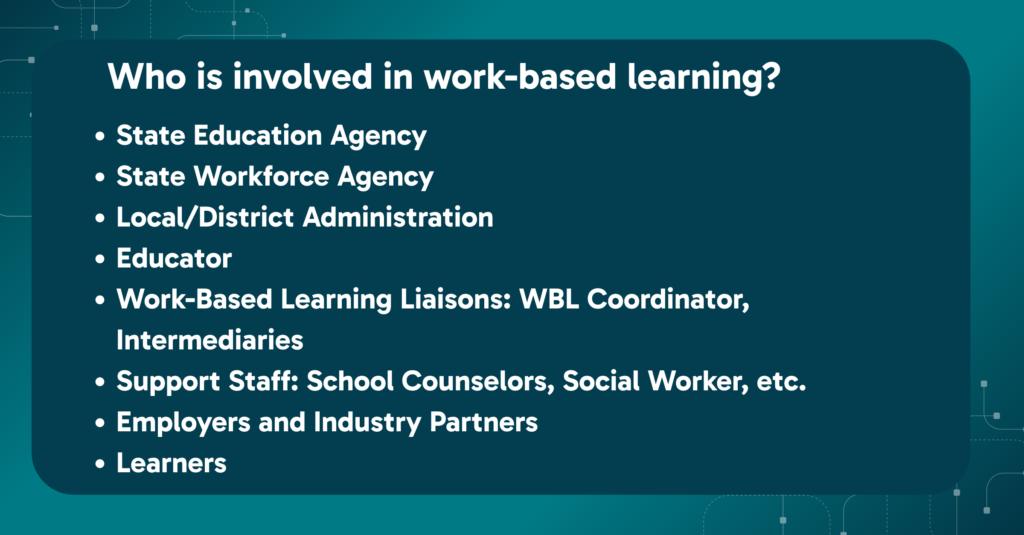
Quality work-based learning experiences require collaboration across a variety of actors at the state, local, and community level, as shown below. Its core relationship, however, is between an employer and a learner. And right now, there is neither enough structure nor consistency to fully support the learner or employer, which is impacting the field’s ability to scale WBL for all.
On one side, employers are inundated with requests to engage in and host work-based learning, and there’s little coordination on the education side behind that outreach. Employers don’t always know what they’re signing up for, either. Too often, education skips straight to the biggest ask, a sustained internship or youth apprenticeship, instead of starting with easier, more career exploration-focused entry points such as career fairs or job shadows. Direct supports for employers around the hiring, supervision, and evaluation of learners also vary widely.
For learners, the challenges are less short-term than long-term. Take, for example, two learners from neighboring districts who both graduate having completed work-based learning. One had a paid, semester-long experience; the other had an unpaid, four-week experience. A graduation requirement or accountability system may treat them the same, but we know those learners had very different experiences and will see very different outcomes.
Setting A National Standard for Work-Based Learning
 As the national organization supporting state CTE leaders, Advance CTE has decades of experience providing state guidance on structures and frameworks to design and deliver WBL, and more recently direct, customized technical assistance to actually build these frameworks in Alaska and New Mexico. We also manage several national frameworks for career readiness, including The National Career Clusters® Framework and a five-year vision for the future of CTE, now in its fourth iteration.
Advance CTE is applying over a century of state member support and experience with employer-informed learning to set a national standard for the quality and impact that employers and learners are looking for in WBL experiences. This fall, we joined forces with BriteBound to launch the National Work-Based Learning Alignment Project. The Project engages education professionals, employers, and learners to build a national consensus and taxonomy that defines, aligns, and measures high-quality work-based learning. Our first phase of work will focus on secondary WBL, but we will actively consider postsecondary transitions, and future work will provide supplemental postsecondary structures.
The final taxonomy will be based on input from the field, but currently it looks like:
- Descriptions of key WBL experiences that include multiple dimensions, including duration, skill attainment, employer engagement, etc.
- Verified list of criteria for a high-quality WBL experience
- Data dictionary to align measures that focus on quality and value
Above all else, the National Work-Based Learning Alignment Project aims to bring clarity and consistency to the field, so that when we talk about, offer, or evaluate work-based learning, we’re working from a common understanding of what it is. We want to send clear signals to everyone engaged in this work, whether at the policy or programmatic level— system and institutional leaders, WBL providers, funders, employers, and intermediaries. When that happens, we better make the case for why WBL should continue to be funded and expanded.
Answering the Big Questions about Work-Based Learning
There is a lot to unpack when it comes to WBL. The National Work-Based Learning Alignment Project will focus on three big questions during the creation of a taxonomy and accompanying resources:
- What are the non-negotiables of a high-quality WBL experience? What structures and resources have to be in place, what are the look-fors of elements and components that must be included, and what criteria can a program be evaluated against to show it was designed with quality in mind?
- How do we classify work-based learning consistently? Experiences can look very different in delivery, and we need a way to understand where policy and funding should align. That taxonomy will have to address a range of considerations, including: What’s the right duration of “sustained” WBL? Which skills or competencies should a WBL experience align to and assess? What role should employers play in design and delivery?
- What common metrics should we use beyond participation? What outcomes matter most across economic, educational, skill-development, learner agency, and social-capital to both evaluate the quality and support program improvement down the line
We recognize these are big questions, and we understand the responsibility we are taking on to create a taxonomy that delivers quality to every learner, while remaining flexible enough to work in states with widely different WBL structures, standards, and legislation. But we’re up to the challenge!
Making Your Voice Heard
This undertaking will only succeed with strong buy-in from the field, from national organizations down to practitioners. We know buy-in starts with consistent input from all sectors of the WBL ecosystem.
We are fortunate to have a great partner in BriteBound, who shares our focus on transformational systems change and has a wealth of partnerships, including their 40+ partner WBL Coalition. Our National Advisory Committee made up of national, state, and local leaders, employers, researchers, and others is meeting regularly and offering guidance along the way. A national survey in Spring 2027 will allow the entire community to offer input on a draft taxonomy.
We need a taxonomy that doesn’t just work for everyone but gets adopted by everyone. Let’s make the most of this moment together.