
Earlier this year, I was at a meeting where the woman next to me shared a story about her son. He had completed a youth apprenticeship in the skilled trades, was offered a job, and turned it down to pursue another pathway in college. To this mother, this was a win. Her son gained skills, earned money, contributed to his company, and made an informed decision about postsecondary education. To the employer, this may be seen as a loss– and a reason to back away from providing such experiences to high school-aged learners in the future. Same learner, same experience, different perspectives on success.
Pretty much daily, I am in conversations with policymakers, national partners, practitioners, and funders where this question comes up: how do we measure return on investment (ROI) in Career Technical Education (CTE)?
The question back needs to be: for whom?

Metrics to Match the Investments
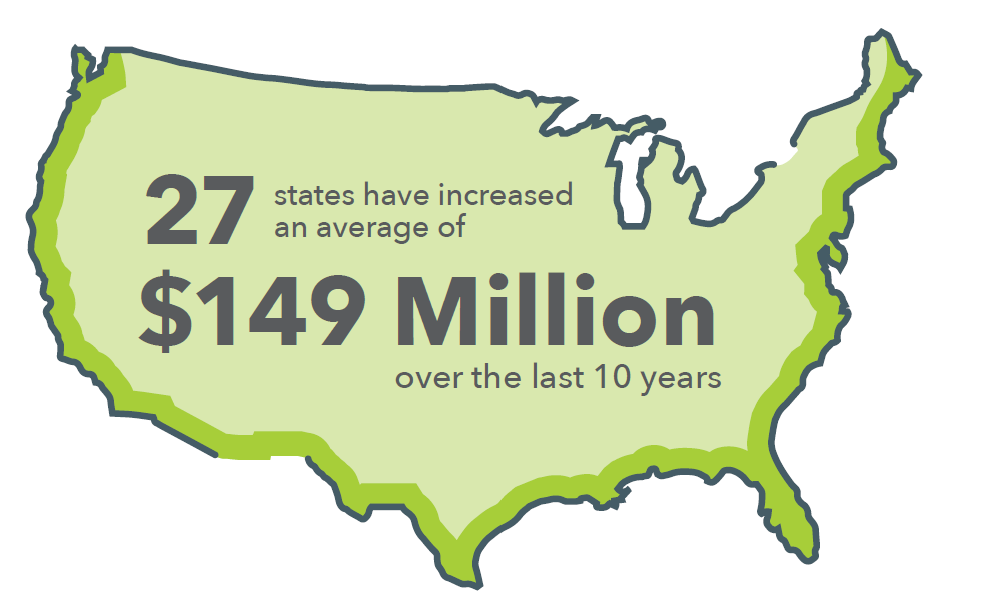
Over the last decade, we have seen major public investments in CTE. Between 2012 and 2022, 27 states increased their secondary CTE funding, representing an average increase of $182 million across those states. Lumina reports states have put at least $1.8 billion into non-degree credentials, investing roughly $511 million in 2025 alone. This is barely scratching the surface of the true scope of how much is being invested, and what still needs to be invested into our CTE system to fully meet the needs of all learners and communities. As Advance CTE and our partners make the case for stronger investments in our CTE system, being able to point to clear returns is critical.
Yet, there isn’t a gold standard for how to measure ROI of CTE. A 2011 study found participation in secondary CTE was associated with increased graduation and decreased dropout rates, translating to an ROI of $168 million in lifetime economic gain for learners. Most viable ROI studies focus on postsecondary CTE learners, which consistently show benefits to the learners (e.g., employment and wages) and/or to the state (e.g., productivity and tax revenue). Perkins accountability is balancing academically-driven outcomes, along with completion and placement in education, training, or the workforce approximately six months after program completion.
A recent study of Delaware’s pathways elevates the core of the ROI tension. The study found very strong outcomes, especially increased postsecondary enrollment and wage benefits for learners enrolled in specific program areas. However, fewer than half of CTE learners continued on in their career field in college or the workforce. The Hechinger Report coverage of this study raised this fundamental question: “Are pathways meant to steer students into specific career fields, or help them figure out what they don’t want to do?”
The answer: both.
The Trouble with a Single Number
The CTE system supports nearly 12 million learners, including 8.6 million at the secondary and 3.3 million at the postsecondary level. In many states, CTE experiences begin as early as fifth grade and extend to adult postsecondary learners. CTE looks different at each learner level– with different levels of intensity, industry engagement, and, therefore, metrics to prioritize.
Depending on where one connects to the system, they will likely have very different answers to these questions:
- Is a CTE program of study worth the investment if learners ultimately choose to enter a different field of study or career upon completion?
- Is a CTE program successful if a learner completes their program and immediately goes to work in their related field, but is making less than a living wage?
- Is CTE worth an employer’s time if they aren’t able to hire any learners directly out of high school or college?
- Is CTE the right choice for one’s child if they plan to go to college upon high school graduation?
- Is CTE worth the investment if a learner needs to go back to be upskilled or re-skilled?
For many policymakers, industry partners, and even funders, they want to hone in on a single number: did the CTE learner get a job in the exact field they trained for?

Public dollars deserve accountability, and CTE is, in large part, about career preparation. But let’s unpack that question and look at what it rewards. It rewards the program that tracks a 15-year- old and keeps them there. It devalues the program that gave a learner a real look at a career, the skills to do it well, and the insight to decide it wasn’t for them. It challenges the importance of learners gaining transferable career-ready skills that give them adaptability and opportunity beyond any single job.
But let’s push in the other direction. If workforce outcomes make you uneasy, especially for high school learners, then we’re asking industry to invest in a system while declining to be accountable for the very thing industry came to the table for. Same narrowness, pointed the other way. The problem was never that one perspective is right and the other wrong. It’s that each has mistaken its slice of the return for the whole.
Returns Not In Conflict, But Connected
One “easy” fix to this issue is just to measure CTE’s return with multiple metrics, but I’d argue that does not take us far enough.
Let’s go back to the mom at that meeting. Her son’s experience was a success– he gained skills, made a real contribution, and made an informed choice about his future. That only reads as success to the employer if the employer can look at a learner who showed up, did work good enough to earn a job offer, and then chose college, and count it as something other than a loss– not out of charity, but because the CTE system doesn’t belong to any single partner and must benefit learners and employers alike to meet its full promise.
When each stakeholder views themselves as a full partner in CTE, not a beneficiary waiting for their own return, the broader outcomes stop looking like someone else’s business and become something that benefits everyone.
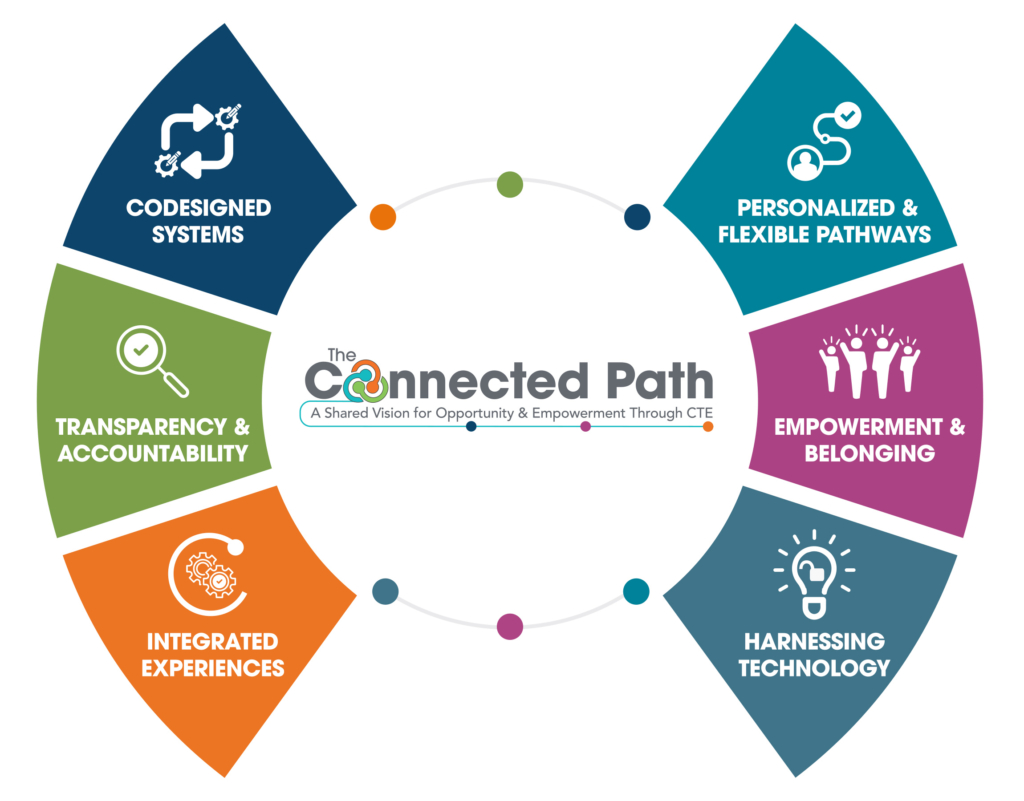
That’s the whole premise of The Connected Path: A Shared Vision for Opportunity & Empowerment through Career Technical Education (CTE Connects), the shared vision stewarded by Advance CTE. The returns aren’t a set of separate ROIs sitting side by side, each defended by the person it benefits. They’re connected— one investment producing value that moves across learners, employers, and the public. The answer isn’t only having better metrics. It’s a field mature and invested enough to recognize value even when the return directly benefits someone else.
What This Will Take
If the goal is a field that can understand the full range of CTE’s benefits and outcomes, the most important thing we can build is public reporting structures that elevate and help communicate the full range of returns.
Two things have to come with it. First, statewide talent strategies that consider the priorities of each key stakeholder (education, workforce, learners, and workers) to guide the overall vision and measures of success. Building from there, we need better data, especially wage data, which is still the single biggest barrier to putting a real-time dollar figure on CTE’s outcomes. Workforce Pell has further pushed on the data challenges, particularly with non-degree credentials, but given that only eight states even report their learner outcome data related to credential attainment, there is still a lot of work to do to strengthen data collection, linkages, and use.
It will also take a willingness to value and measure “indirect benefits” of CTE. New America recently found four benefits of youth apprenticeship that employers rarely count and no CTE dataset captures: renewed engagement of staff, the opportunity to provide more managerial experience to junior staff, increased collaboration, and improved training systems. CTE Connects also calls for us to develop measures for learner agency and social capital, which should be very much developed through CTE.
None of this happens alone. It takes all partners coming together to identify the full range of outcomes they care about– and then advocating together to bring that data to life.
Back to the path
CTE Connects asks the field to recognize CTE’s value even when the return isn’t their own: for employers to have a stake in the learner who chooses another path, for families to value the impact of CTE on their local economy, and for policymakers to consider both of these as equally viable outcomes. That’s the harder standard, and the truer one, measuring CTE by the full range of what it returns, and to whom.