This is the first post in Building the Connected Path, a blog series exploring the tensions—real and perceived—shaping Career Technical Education (CTE), and how a new shared vision stewarded by Advance CTE, The Connected Path: A Shared Vision for Opportunity & Empowerment through Career Technical Educating (CTE Connects), can help the field navigate them.
 CTE is complex, with a lot of moving parts and a lot of tension points, some more visible than others, that policymakers, program designers, and practitioners regularly grapple with as they make decisions about CTE programs and experiences. Our fifth shared vision for the field, CTE Connects, doesn’t shy away from these tensions. Rather, it surfaces them and its six principles offer a roadmap forward.
Through this series, I’ll dig into these tensions one at a time, unpacking where they’re real, where they’re not, and what it takes to move through them. Some, like the one I’m starting with, fall apart under closer examination. Others, like how we define return on investment or where the line falls between education and workforce systems, are genuinely harder.
And while those tensions may not be fully resolved, they are still critical to engage in to ensure CTE can fully live up to its promise to learners, employers, and communities. It is incumbent upon all of us to explore these tensions more carefully than the framing usually allows, and CTE Connects gives us the language and the principles to do that work.
Let’s start with the one I get asked about most.
Finding the Balance
The first principle of CTE Connects calls for a CTE system that is codesigned by education and industry. It’s the right starting point, and it surfaces a question I hear often: How can CTE be both industry-led AND learner-centered? Aren’t those in conflict? What happens when an employer needs one thing and a learner wants something else?
These are fair questions and merit time and attention. But I don’t actually believe these are competing values. Industry-led and learner-centered aren’t at odds, as the two main beneficiaries of CTE programs, their input is equally important and key to the success of CTE. Industry-led isn’t the opposite of learner-centered. It’s the foundation that makes learner-centered design possible when both voices are at the table from the start.
We saw this play out clearly in our recent work modernizing the National Career Clusters Framework. The Framework had to be deeply industry-driven, grounded in quantitative labor market data and qualitative input from more than 100 industry representatives via our industry advisory groups. It had to reflect the language of industry today and where industry is heading in the future.
But the Career Clusters also had to be a tool that learners could engage with and see themselves in, one that resonated with their interests, sense of purpose, and the choices they were trying to make about their futures.
Industry-led isn’t the opposite of learner-centered. It’s the foundation that makes learner-centered design possible when both voices are at the table from the start.
Before we began any work, we conducted learner focus groups and employer interviews to understand what mattered to each of them.
- In the learner focus groups, we proposed alternative ways of describing the Career Clusters to better understand what motivated them and got them excited about future opportunities.
- In the employer interviews, we focused on what they were looking for in new hires, how they described their industry, and overall impressions of CTE.
You can see how this plays out in the names of the Clusters. Each Career Cluster reflects an industry sector, so employers can see themselves in the Framework, and each also has a purpose-driven tagline that helps learners connect to their why.
| FOR INDUSTRY
Cluster reflects the sector |
FOR LEARNERS
Tagline reflects the purpose |
| Agriculture | Cultivating sustainability and nourishing the world |
| Advanced Manufacturing | Engineering and producing tomorrow’s solutions |
| Healthcare & Human Services | Supporting the whole health of individuals, families, and communities |
| Marketing & Sales | Improving communication and connections |
Dr. Michael Hill-Shaner, an Education Associate at the Delaware Department of Education who leads learner engagement efforts for Delaware, summarizes the balance perfectly:
“Industry helps ensure programs remain relevant, rigorous, and connected to real workforce opportunities, but learner-centered design pushes us to ask deeper questions around access, identity, engagement, belonging, and long-term mobility.”
The bottom line is that the input and perspectives of both audiences were essential. Neither was in conflict with the other. By being deliberate about what we were asking each of them, we were able to ensure that the final structure reflected the needs of both.
Industry Defines the What; Learners Shape the How
Here’s the cleanest way I’ve come to think about it: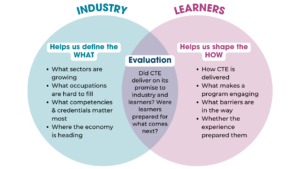
- Industry helps us define the what. What sectors are growing. What occupations are hard to fill. What technical and durable competencies and credentials matter the most for hiring and advancement. Where the economy is heading.
- Learners help us shape the how. How CTE is delivered. What makes a program engaging and relevant. What barriers are getting in the way. Whether the experience actually prepared them for what comes next.
Where these two groups overlap in providing input is from an evaluation standpoint: did CTE deliver on its promise to industry and learners by ensuring learners were prepared for what comes next?
Questions to ask employers:
- What jobs are you struggling to fill today, and which ones do you anticipate struggling with in the future?
- What technical and durable skills and credentials do you most value when making hiring decisions?
- Where is your sector going, and what skills will matter most as the economy evolves?
- What would make work-based learning most valuable to your business, and what do you need to host learners well?
- Are learners coming out of CTE programs meeting your expectations and needs? If no, why not, and what needs to change?
Questions to ask learners:
- What experiences, in the classroom or on a worksite, have been most valuable to you?
- How has your CTE program made you feel welcome, supported, or valued?
- What barriers have made it harder to participate or stay engaged?
- How could the program, or your engagement with employers, have been better?
- Looking back, did your CTE program actually prepare you for the world of work? If no, why not, and what needs to change?
Where This Gets Harder
There is one place where the tension is real, and it’s worth naming honestly. Across the country, we sometimes see districts and institutions offering programs without strong labor market demand in their region. When we ask why, the answer from educators is usually some version of: these are the programs learners show up for. This is what gets them excited about school. If we cut this program, our learners won’t come to school anymore.
This shouldn’t be taken lightly. CTE’s ability to draw in learners–including those who might otherwise disengage from school–is one of its most powerful features and critically important. But engagement cannot be the only way to measure impact and outcomes. Enrolling learners in pathways that don’t connect to a good job in their community, without being honest with them about that, isn’t a trade-off we should be making.
The harder, better path is intentional program design that holds both: programs that pull learners in and lead somewhere meaningful. This just underscores why learners need to be engaged throughout policy and programmatic discussions so they can give input, but also understand the economic mobility that high-quality, industry-aligned programs can provide.
What Does This Look Like in Practice
A few states are already showing what codesign looks like when both voices are built into the system, not an add-on:
- Delaware involves learners in the review and redesign of all CTE programs of study, reviewing what industry has set as the expectation to ensure the programs meet learners’ needs and learning styles.
- Colorado requires learner representation on local CTE advisory committees, a structural commitment to learner voice in the same rooms where industry input shapes programs.
- Kentucky has leaned into getting learner input at multiple levels and has committed to 100% of their programs of study tied to high-skill, in-demand fields.
Looking Ahead
When tension arises between “industry-led” and “learner-centered,” it is a sign that we don’t have the right systems or structures in place to get the right answers to the right questions at the right time. CTE Connects gives us the vision to make that the norm.
Each post in this series will land on a different connection point, some that resolve cleanly, some that don’t. The goal isn’t to dissolve every tension, but to look at each one carefully enough to understand what it’s actually asking of us and to show how CTE Connects gives the field a shared vision and shared language for working through them together. I’m proud to lead an organization that’s willing to have these tough conversations and provide a path to navigate these tensions and eliminate unnecessary silos.
In the next post, I’ll turn to a tension that doesn’t resolve as cleanly: how we define return on investment for CTE and why I think we need to be okay with multiple definitions sitting alongside each other.