When baking a cake, what comes to mind? You probably think about the ingredients you need, the cake’s flavor, and how it will all be mixed together to bring a recipe to life. A homemade cake likely requires precision and a bit of extra brainpower. While time-consuming, baking a cake can be a rewarding experience, yielding a sweet, decadent treat.
Aligning education and workforce systems often follows a similar process. State leaders have to decide on their desired result, determine what they need to achieve it, and discern what unique elements are needed to make their goal work statewide, all while patiently watching their inputs work together. The result can lead to a stronger workforce and expanded educational and career options for learners.
 In Kentucky, the Tech Ready Apprentices for Careers in Kentucky (TRACK) program is a layered cake with icing in the middle. Education and workforce leaders are cooking up, or “codesigning,” an aligned system that achieves shared goals and impact, with everyone getting a piece of the cake.
Choosing an Approach to Align CTE and Youth Apprenticeship
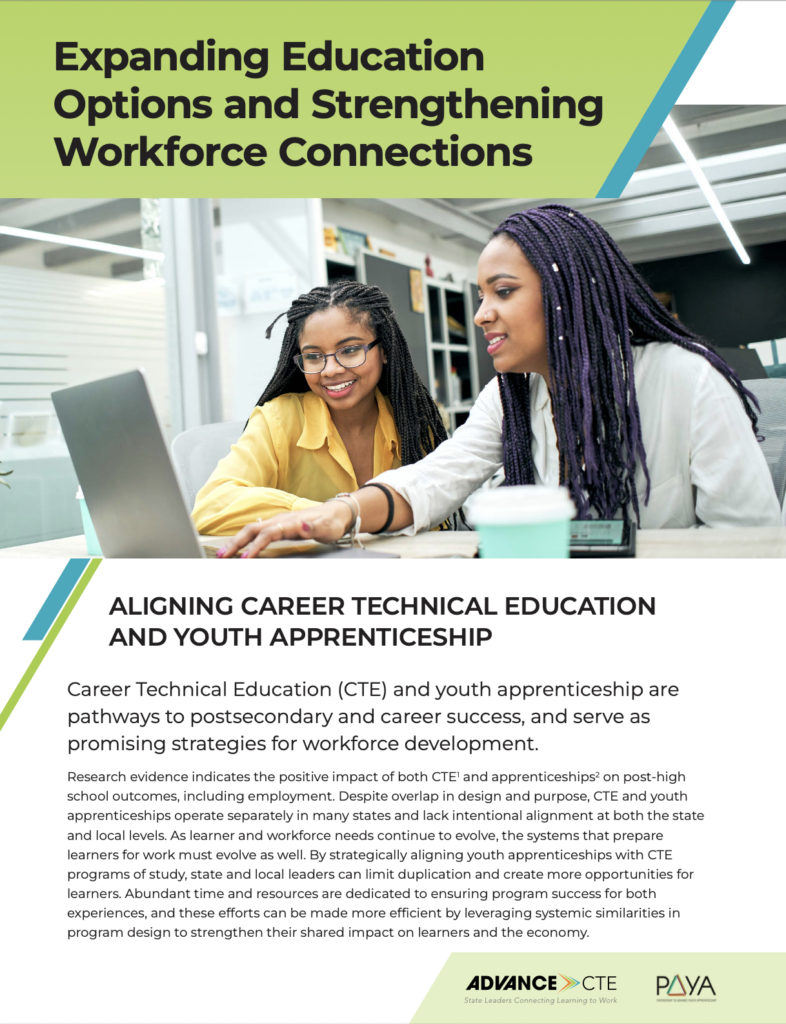 Bakers first need to decide what their taste buds are yearning for and choose a cake’s flavor and recipe. For state leaders, this means learning about different approaches to alignment and choosing one that best suits the needs of their state’s learners and industry. Advance CTE’s recent publication, Aligning CTE and Youth Apprenticeship, provides state education and workforce leaders with multiple approaches and guidance for aligning CTE and youth apprenticeship systems, featuring Kentucky and other states. In Kentucky, TRACK began as a youth apprenticeship pilot after state leaders developed an appetite for an alignment model that would satisfy their education and workforce needs. Education leaders recognized that CTE learners were an ideal pool for youth apprentices given their engagement in career development activities, technical instruction, and other overlapping programming. Those leaders then collaborated across state education and labor agencies to establish processes to create and sustain their alignment model.
Core Elements of Kentucky’s TRACK Program
TRACK’s program has 4 core elements that work as ingredients in its alignment recipe. In Kentucky, state CTE and apprenticeship leaders held formal meetings to deepen relationships and develop shared goals, parameters, and incentives to create a flavor just right for their state.
- Curriculum and instruction: TRACK was intentionally designed for CTE concentrators, and CTE courses count as related technical instruction (RTI) for the apprenticeship.
- Application of credits: Credits earned during the apprenticeship may count toward a postsecondary degree where applicable.
- Partnerships: Consistent collaboration and coordination among different agencies, including the Department of Education and the Department of Workforce Development, help sustain TRACK.
- Policy: Kentucky has legislation that helps fund youth apprenticeship costs, provides financial incentives for districts to include youth apprenticeship outcomes in their accountability measures, and establishes articulation agreements between secondary and postsecondary institutions.
Strategies for Strengthening CTE and Youth Apprenticeship Alignment
In addition to state approaches to alignment, the publication also provides strategies to help initiate or strengthen alignment. States can use this guidance as they bring their core elements (ingredients) together to align CTE and youth apprenticeship. Strategies include:
- Creating shared goals, roles, and responsibilities between CTE and youth apprenticeship departments through collaboration and coordination.
- Analyzing and leveraging enabling conditions, such as current partnerships and existing policies, to initiate or strengthen alignment.
- Deciding on an alignment model that best fits the state context. Each state may have similar approaches, but what works in one district, region, or state will likely not be applicable across all contexts.
- Building awareness for local education agencies, employers, partners, families, and learners.
As state leaders think about the core elements of alignment and the steps they need to follow, they should not be looking to make a replica of another state’s cake, though. Just as a baker has to figure out which flavor their customers like the most, state leaders have to understand the needs of learners and industry partners and apply their state context when choosing an alignment model that works best for all partners. Colorado, for example, passed legislation explicitly requiring CTE and apprenticeship offices to collaborate. Kentucky, on the other hand, leverages existing relationships and policies to build out system alignment and create financial incentives for districts.
Each state has to determine how it wants curriculum delivered, which credits can be applied and where, which current or potential policies can enable alignment, and which partnerships are needed and how they will work together. Multiple states can share the same core ingredients, but the processes for developing and implementing alignment (the precise measurements) all create a flavor unique to that state.
Codesigning with Industry Partners
 Part of the reason for TRACK’s success is that alignment is codesigned; there is not just one chef in the kitchen. CTE Connects outlines ways in which industry and education can work together to create a coherent CTE system with common goals and strategies. These types of partnerships within TRACK embody Principle 1 within CTE Connects, as they maintain collaborative efforts that engage employers across the CTE continuum:
- Education and workforce have mutual investments in creating solutions for shared challenges;
- Members of different agencies serve on committees and engage in ongoing conversations to understand the challenges facing education and the workforce, and the role that each agency plays in addressing the collective challenges facing learners and industry;
- Industry provides input into CTE programs of study curriculum, and employers share responsibility for apprenticeship development; and
- CTE systems provide learners with career development and preparation for successful participation in apprenticeships.
CTE Connects and Aligning CTE and Youth Apprenticeship serve as a couple of cookbooks—guides to success that help states envision how to bake their ingredients (curriculum, credit articulation, policies, partnerships) and desired flavor (state context, priorities, goals) together.
Getting Started
It is now time to put that cake in the oven. A first-time baker may want to start with a simple recipe—maybe a basic flavor with a single-layered cake. Similarly, for state leaders, initiating alignment between CTE and youth apprenticeship may begin with a single or small set of CTE programs and industries that have demonstrated success in this alignment across contexts. Before a cake is ready to eat, it needs time to cool. For CTE and youth apprenticeship systems to be fully aligned, there needs to be time to collect data on outcomes, access, successes, and challenges to ensure everyone can get a slice of the outcome. Lastly, bakers taste the cake and alter a recipe as needed. Likewise, state leaders initiating alignment should continue to explore what works and what does not, and reference cookbooks and recipes (resources and frameworks) to support them. Even if your cake doesn’t turn out well the first time, don’t worry! You have a network of peers and colleagues to support your next effort.
Hungry for more? Be sure to check out the publication and CTE Connects.